
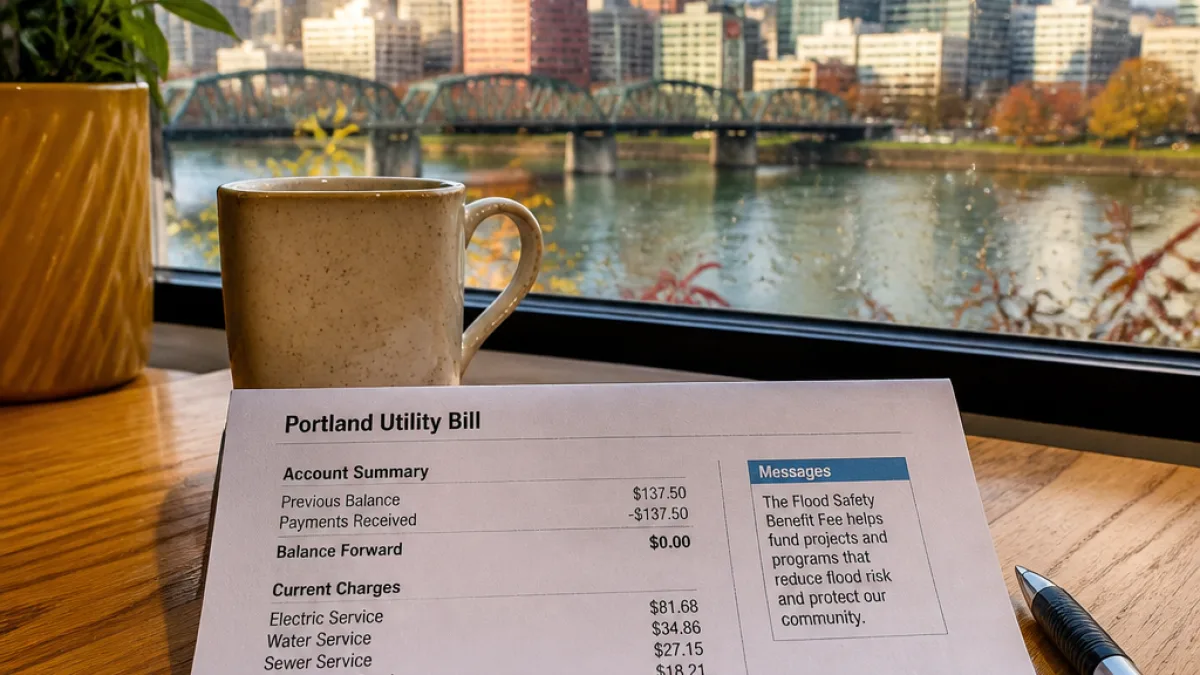
Portlanders opening utility statements this month noticed a line they hadn’t seen before: a new Flood Safety Benefit Fee intended to bankroll regional flood-safety projects. The charge, added to city utility bills July 1, is designed to fund infrastructure overseen by the Urban Flood Safety and Water Quality District.
What residents will pay
For the average single-family home, the fee appears as $3.60 on a typical 90-day utility bill — roughly $1.20 per month. The Portland Water Bureau said households enrolled in the city's financial assistance program will pay a reduced amount: $1.80 per 90-day bill, or about $0.60 per month.
“The Flood Safety Benefit Fee helps fund flood safety infrastructure managed by the Urban Flood Safety & Water Quality District,” said Brandon Zero with the Portland Water Bureau in a statement to FOX 12.
The new charge is part of a wave of recent rate increases, taxes and fees that city officials and advocates say are needed to maintain and improve public systems. Critics of the changes have pointed out cumulative cost impacts on households.
How the fee compares and who gets relief
The city has framed the assessment as a modest, targeted revenue source for projects meant to reduce flood risk and improve water quality across the district’s jurisdiction. Still, details about specific projects and deployment timelines are being managed at the district level rather than directly through the water bureau billing statement.
- Standard fee: $3.60 per 90 days (~$1.20/month)
- Reduced fee (financial assistance): $1.80 per 90 days (~$0.60/month)
- Administered by: Urban Flood Safety and Water Quality District
| Customer type | 90-day fee | Approx. monthly cost |
|---|---|---|
| Single-family home (standard) | $3.60 | $1.20 |
| Financial assistance customers | $1.80 | $0.60 |
Local context: cumulative costs and public reaction
Portlanders have faced a string of new charges in recent months. A FOX 12 investigative report calculated that when recent taxes, fees and rate increases are combined, a typical household could shoulder roughly an additional $700 annually. That estimate has become a touchstone for public concern about affordability even as city and regional officials point to aging infrastructure and climate-driven risks that demand investment.
For many households, the new flood fee may feel small on its face. For others, particularly families already qualifying for financial assistance, every new line item in a utility bill matters. The city’s existing discount programs will temper the burden for qualifying customers, but enrollment and outreach will determine how many people actually receive that relief.
What's next
The fee is now part of routine billing. Questions that remain for residents are familiar ones for municipal policy in a time of tight household budgets: how the district will prioritize projects, how funds will be spent transparently, and whether additional charges are coming as climate pressures grow.
Portlanders should expect communications from city and district officials outlining specific investments and timelines in the months ahead. In the meantime, utility customers can review their account statements for the new line item and, if eligible, verify enrollment in the city's financial assistance program to receive the discounted rate.
Small on the face of a single bill, the fee is part of a larger civic calculation: balancing immediate household affordability against long-term risk reduction for a city that sits where waterways converge. That trade-off will shape debates — and bills — to come.