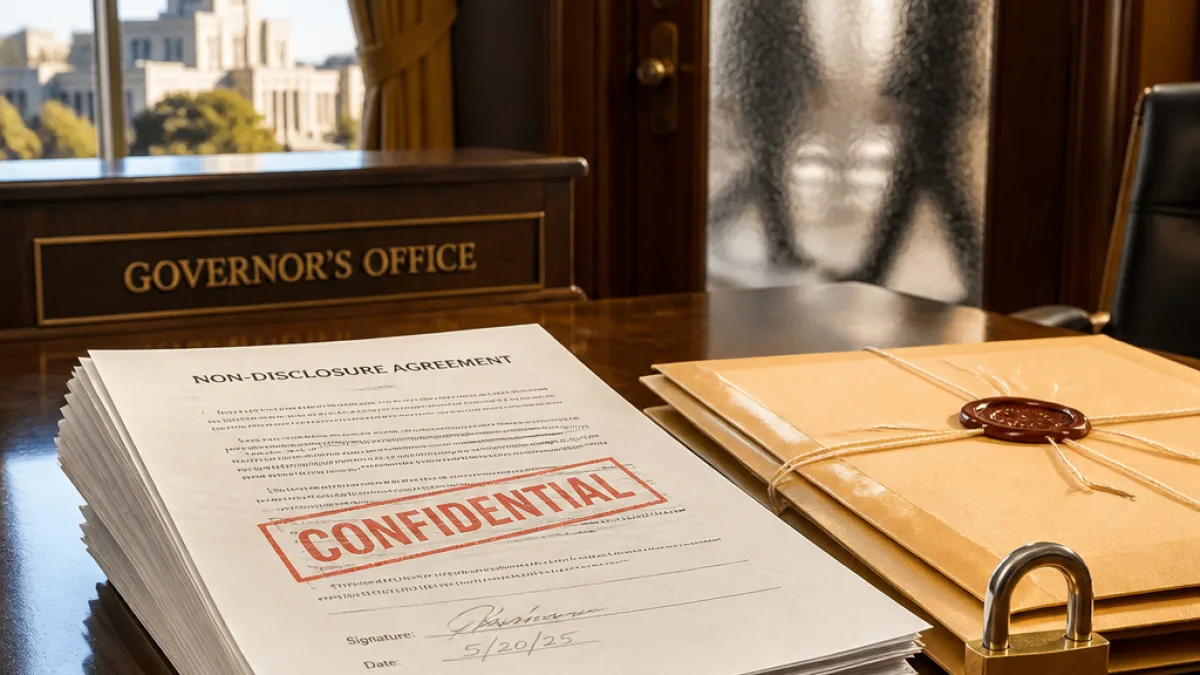
The Landry administration placed at least 121 current and former staffers under sweeping confidentiality agreements that bind employees — from senior aides to short-term temps — to secrecy about matters learned while working for the governor, according to records obtained by Gulf States Newsroom and Type Investigations.
Scope and signatories
The documents include high-ranking figures in the administration: former Chief of Staff Kyle Ruckert, Executive Counsel Angelique Freel and Deputy Chief of Staff for Communications Kate Kelly are among those listed as having executed nondisclosure agreements. Agency heads, regional directors, press officers and members of the first lady’s office also signed the forms, the records show. One signer was a deputy executive counsel who, according to the files, handled public records requests for the governor’s office and provided the records used in the reporting.
| Item | Detail |
|---|---|
| Number of employees who signed | 121 |
| Notable signers | Kyle Ruckert, Angelique Freel, Kate Kelly |
| Corporate NDA involving governor | Mutual NDA with Laidley LLC (Meta subsidiary), April 2024 |
Where the records fit in
The reporting was produced in partnership with the Springboard Project at Type Investigations and drew on records obtained by Gulf States Newsroom. The documents show the administration has used broad confidentiality provisions not only within the governor’s immediate office but across parts of state government. Some people who signed the agreements later left state service; others remain at work.
Corporate connections and a signed NDA
The records also show Gov. Jeff Landry personally executed a “Mutual Non-Disclosure Agreement” in April 2024 with Laidley LLC, the data-center subsidiary of Meta Platforms. That agreement surfaced alongside reporting about Meta’s proposed data center campus in Richland Parish; public filings have linked the campus development to a potential investment value of roughly $50 billion.
Concerns from experts and the public interest
Legal observers and transparency advocates warn such agreements can chill speech among public employees, intimidate workers and limit the public’s ability to understand how government decisions are made. The confidentiality terms described in the records were characterized by critics as potentially sweeping enough to extend beyond traditional trade-secret protections and into areas of routine public work.
- Agreements apply to a wide range of staff roles, including temporary workers.
- At least one official who managed public records requests had signed the NDA.
- Some senior officials who signed the NDAs later left state employment.
What this means for transparency
When confidentiality clauses are applied to government employees, they raise questions about the boundaries between legitimate protection of proprietary information and the public’s right to know. Public employees frequently handle policy deliberations, constituent concerns and procurement matters that are ordinarily subject to public-records laws; restricting their ability to speak or disclose information could complicate oversight and the press’s access to government documents.
Those concerns are heightened when NDAs intersect with major economic development projects. The records show a direct confidentiality agreement between the governor and a corporate subsidiary involved in a high-value data-center proposal for northeastern Louisiana.
Administration response and next steps
The records themselves detail the signed agreements but do not, by themselves, interpret how the administration intends to enforce them or whether they would be used to bar employees from cooperating with public records requests or speaking to journalists. Questions remain about whether the agreements conform to state law and established norms for public service. Reporters and watchdogs will likely press for answers about how the clauses are applied in day-to-day government operations and whether any discipline or litigation has arisen from them.
The disclosures add to an ongoing conversation in Louisiana about the balance between government confidentiality in contract negotiations and the public’s right to oversight. For citizens and journalists in a state where extractive industries and large-scale projects often reshape local economies, the stakes are tangible: how much of the process remains visible, and who controls the story?
As this reporting continues, the records released so far provide an initial inventory of who signed and when; they leave open broader legal and policy questions about the use of nondisclosure agreements in public office.