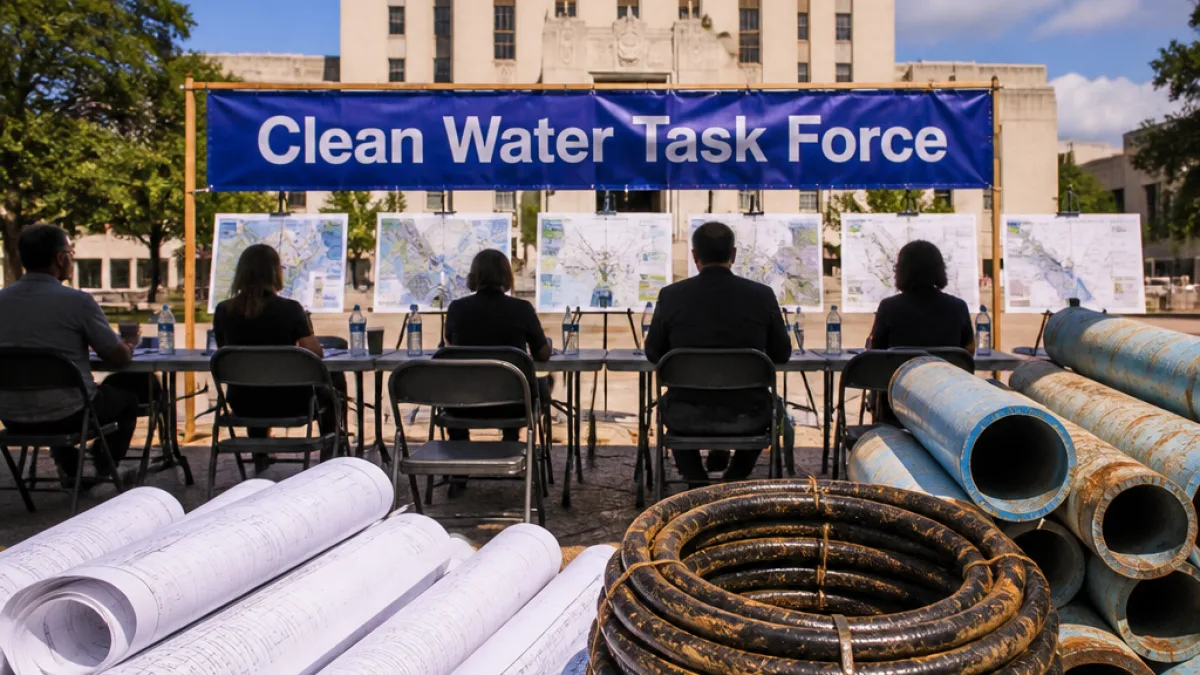
A new panel gathers at Government Plaza
The humidity of a late July morning hung over Government Plaza as a state-created Clean Water Task Force held its first meeting Wednesday, confronting an issue that has dogged Shreveport residents: the municipal water system’s second consecutive failing grade from the Louisiana Department of Health.
Established under House Resolution 367, sponsored by state Rep. Joy Walters, the task force assembled city officials, state lawmakers and water and public health experts to begin diagnosing the system’s problems and sketching recommendations for improvement. The meeting was framed as the start of a months-long effort to find practical fixes for both technical and customer-facing issues.
Problems beyond water chemistry
Shreveport has drawn scrutiny in recent years over reports from residents about water discoloration, odor and cloudiness. The state score — an F for the second straight year — reflects not only measured water quality but also infrastructure conditions, sustainability concerns and the volume of consumer complaints, officials said.
"We've all been to school. We all know an F is not a good grade," said Tom Dark, Shreveport's chief administrative officer. "So we're trying to work our way up from there. I think you will see improvement there over the next few years."
Dark defended the city's drinking water record in technical terms, telling the panel that Shreveport's system meets federal Safe Drinking Water Act requirements "almost all of the time". He said the primary chemical exceedance is trihalomethanes, byproducts of disinfection, and that city staff believe they have "a better handle on" those instances.
Local leaders question the grading scale
City officials pushed back on the state’s scoring method, arguing it does not sufficiently account for the scale of a large system. Dark noted that the same complaint thresholds apply to tiny systems as to a city the size of Shreveport, saying a locality could be penalized the same number of points for as few as 10 complaints — a metric he said disadvantages larger utilities.
- Task force established by House Resolution 367 to study Shreveport’s water system.
- Shreveport has received an "F" grade from the Louisiana Department of Health for two consecutive years.
- Officials highlighted issues including aging infrastructure, sustainability, and consumer complaints; trihalomethanes cited as a common exceedance.
What the panel will examine
While the task force has not yet released a schedule of recommendations, participants said its work will be aimed at identifying where lawmakers and local leaders can intervene to stabilize and improve the system over time. Rep. Walters framed the panel’s purpose as ensuring reliable drinking water for future generations.
| Issue highlighted | Implication |
|---|---|
| Trihalomethane levels | Periodic exceedances of disinfection byproduct limits |
| Aging infrastructure | System sustainability and maintenance challenges |
| Customer complaints | Contribute to state grading and public concern |
The panel’s composition — a mix of city and state officials plus experts — signals an approach that will weigh both technical fixes and policy levers, such as funding and regulatory adjustments. City leaders emphasized they want the grading conversation to consider the logistics of operating a large system and the realities of customer service complaints in an urban setting.
Outlook for residents
For residents who have noticed cloudy water or unpleasant tastes and smells, the task force represents a formal step toward accountability and, potentially, funding or policy changes that could produce measurable improvements. Dark forecasted visible progress "over the next few years," but the pace and scope will depend on the task force’s findings and any legislative or budgetary action that follows.
As the panel moves from diagnosis to recommendations, Shreveport households will watch for practical guidance on reducing exposure risks, boil-water advisories if warranted, and timelines for infrastructure projects. The state’s failing grade has crystallized longstanding grievances; now lawmakers and local officials must translate the task force’s work into fixes that residents can see and taste in their kitchen sinks.