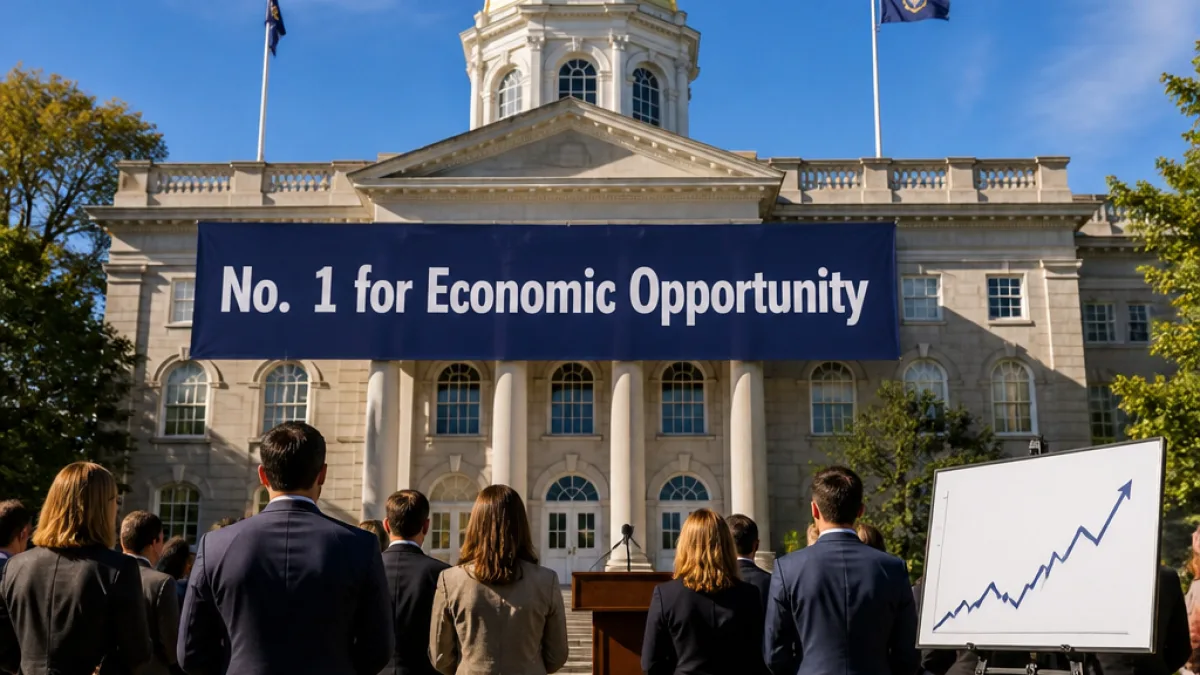
CONCORD — New Hampshire is back at the top of a national list that matters to politicians, employers and anyone thinking about where to plant roots: U.S. News & World Report’s ranking of states for economic opportunity.
Officials frame ranking as validation of policy
On July 28, Governor Kelly Ayotte used the report to underline what she called the state’s long-running advantages: no broad-based state income or sales tax, a light regulatory touch and an environment that welcomes business growth. State economic leaders described the ranking as the payoff of a deliberate strategy.
“New Hampshire is a beacon of opportunity in New England and for the nation, and it’s no surprise that we once again rank #1 in the country for economic opportunity,” the governor said.
Lucy Lange, commissioner of the Department of Business and Economic Affairs, said the result was deliberate policy in action: fiscal restraint, economic freedom and fewer administrative hurdles. Business groups joined the praise: Mike Skelton, president and CEO of the Business and Industry Association of New Hampshire, said the accolade reflected strong public-private partnerships.
What the praise included — and what officials say still needs work
State leaders did not claim the ranking closes the book on economic challenges. In the same release, officials and business representatives pointed to the familiar next steps: expanding affordable housing, increasing childcare access and growing the workforce so employers can hire locally.
- Tax environment: Officials emphasized the absence of a state income and sales tax as a competitive advantage.
- Business climate: State leaders credited a regulatory and administrative approach they say helps businesses scale.
- Next priorities: Affordable housing, childcare capacity and workforce development were identified as areas that must keep pace with growth.
That mix of celebration and caution is familiar to anyone who follows Granite State politics: elected officials take pride in rankings that validate policy choices, while business groups and agencies use them to press for targeted investments that keep the momentum going.
Why the ranking matters locally
Rankings from national outlets like U.S. News shape perceptions beyond state lines — and perception can become reality. Businesses looking to relocate or expand often use rankings as a data point when deciding where to invest. For residents, a high ranking can mean stronger property values and a healthier job market; for policymakers, it offers political capital and leverage for future initiatives.
But a top spot doesn’t solve the day-to-day headaches for employers who say they still struggle to find workers with the right skills, or for families squeezed by housing costs and limited childcare slots. Officials acknowledge those problems; their response so far has been a combination of targeted incentives, partnerships with employers and appeals to federal funding where available.
Quick snapshot
| Item | What officials said |
|---|---|
| Ranking | No. 1 for economic opportunity (U.S. News & World Report) |
| Date announced | July 28, 2026 |
| Promoted strengths | No income or sales tax; business-friendly rules; quality of life |
| Areas for improvement | Affordable housing, childcare, workforce development |
It’s worth noting that rankings are built on particular metrics. Different reports weigh education, health care, wages, cost of living and other measures in different ways, so being No. 1 on one list doesn’t mean the state tops every index. Still, the state’s leaders are using this one to argue the overall direction is right.
Reaction from the business community
Mike Skelton of the Business and Industry Association stressed collaboration: the ranking, he said, is a reflection of partnerships between state government and private employers. He also warned that keeping the lead will require continued attention to the housing and childcare issues that limit workforce growth.
Officials framed the ranking as both a win and a mandate. If you listen past the press release, the underlying message is familiar: celebrate, but don’t get complacent. The state can tout the No. 1 spot while continuing to push policies designed to translate that prestige into tangible improvements for families and employers across New Hampshire.
For now, the brass band gets a moment on the courthouse steps. The tougher work — building enough homes, child-care seats and training programs to match employers’ needs — is still waiting in the wings.