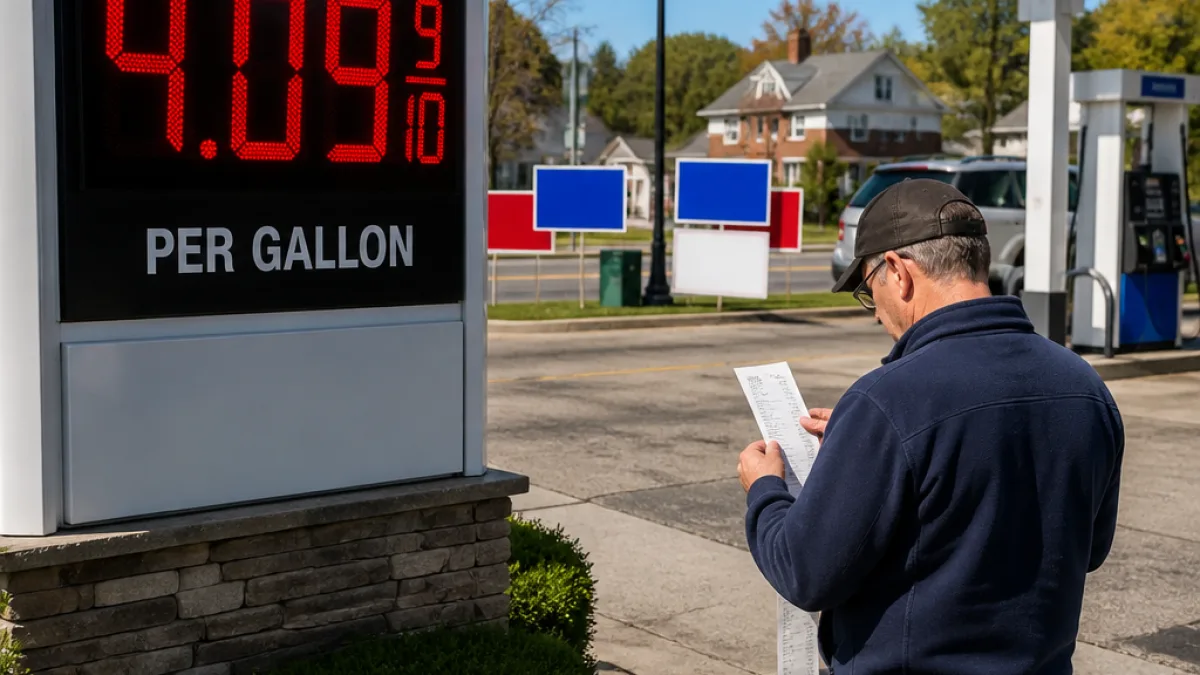
Something as simple as filling a tank of gas has become political currency in New Hampshire. With AAA Northern New England reporting the average price at $4.09 in the state — up from $3.99 a month ago and $2.98 a year ago — candidates vying for the Granite State’s U.S. Senate seat are centering messages on rising costs that touch nearly every household.
A campaign shaped by prices
On the campaign trail, inflation and the rising cost of essentials from gasoline to groceries are more than sound bites; they are organizing themes. Democrats and Republicans alike are pointing fingers at policy choices and international events, trying to turn economic pain into voter momentum.
U.S. Rep. Chris Pappas, D-N.H., who is running for the Senate, blamed recent federal policy choices and global tensions in a written statement. He tied Republican-backed legislation to reduced access to affordable health care and singled out what he called the financial fallout of conflict in the Middle East.
“New Hampshire families continue to feel the economic pressure of Donald Trump’s reckless war of choice with Iran and costly tariffs driving up the price of everyday essentials,”
Pappas’s campaign also cites analysis from the N.H. Fiscal Policy Institute that criticizes last year’s reconciliation law — informally referenced in public debate as the “One Big Beautiful Bill.” The institute’s review found that two-thirds of the bill’s federal tax cuts benefit the top 20 percent of households by income and that the law results in $2.3 billion less in Medicaid funding for New Hampshire.
On the other side, Republican U.S. Senate contender John Sununu is pitching a different prescription: limit taxation and restrain government spending. His campaign messaging pledges to “oppose all middle-class tax hikes and work to make life more affordable for New Hampshire families by focusing like a laser on reducing inflation and lowering the cost of housing, healthcare, and energy,” according to his campaign website.
Local officials and national events collide
Even elected officials who are not on the ballot this year are engaging in the conversation. U.S. Sen. Maggie Hassan, D-N.H., who is not up for re-election until 2028, visited a locally owned grocery store in Portsmouth recently and publicly attributed some of the price increases to the U.S. war with Iran.
The interplay between national policy, international conflict and local pocketbook effects gives campaigns plenty of material. Candidates are framing the same economic statistics to different ends: Democrats highlight widening inequality and cuts to safety-net programs, while Republicans emphasize tax restraint and cost-of-living relief.
What the numbers say
Gasoline prices provide a sharp, easy-to-grasp example of the trend that voters feel in real time. The AAA figures cited by campaigns show a clear upward trajectory in fuel costs over the past year.
| Measure | Price |
|---|---|
| Average price now (AAA) | $4.09 |
| Average price one month ago | $3.99 |
| Average price one year ago | $2.98 |
What this means for voters
For Granite Staters, the debate is not abstract. Families juggling mortgage or rent, childcare, prescriptions and the weekly supermarket run are watching which arguments resonate: are higher prices the result of global instability, federal policy choices, or both? And which fixes will be meaningful without unintended tradeoffs?
- Affordability: Candidates promise different approaches to lowering costs — from opposing new taxes to protecting Medicaid funding.
- Health care: Changes to federal policy are a touchstone, with the Fiscal Policy Institute pointing to Medicaid cuts tied to recent legislation.
- Energy and inflation: Both campaigns cite inflation and energy prices, but assign blame differently.
Campaigns will keep the pressure on
As the campaign season advances, expect both sides to keep hammering on what voters already say matters most: can their household finances get better? With gas and grocery prices serving as immediate proof points, the political fight over who caused the squeeze and who can fix it will only intensify.
For Granite Staters, the choice will feel personal — a reminder that when it comes to voting patterns, economists’ dry data often lands squarely in the kitchen, where budgets are balanced and decisions are made.