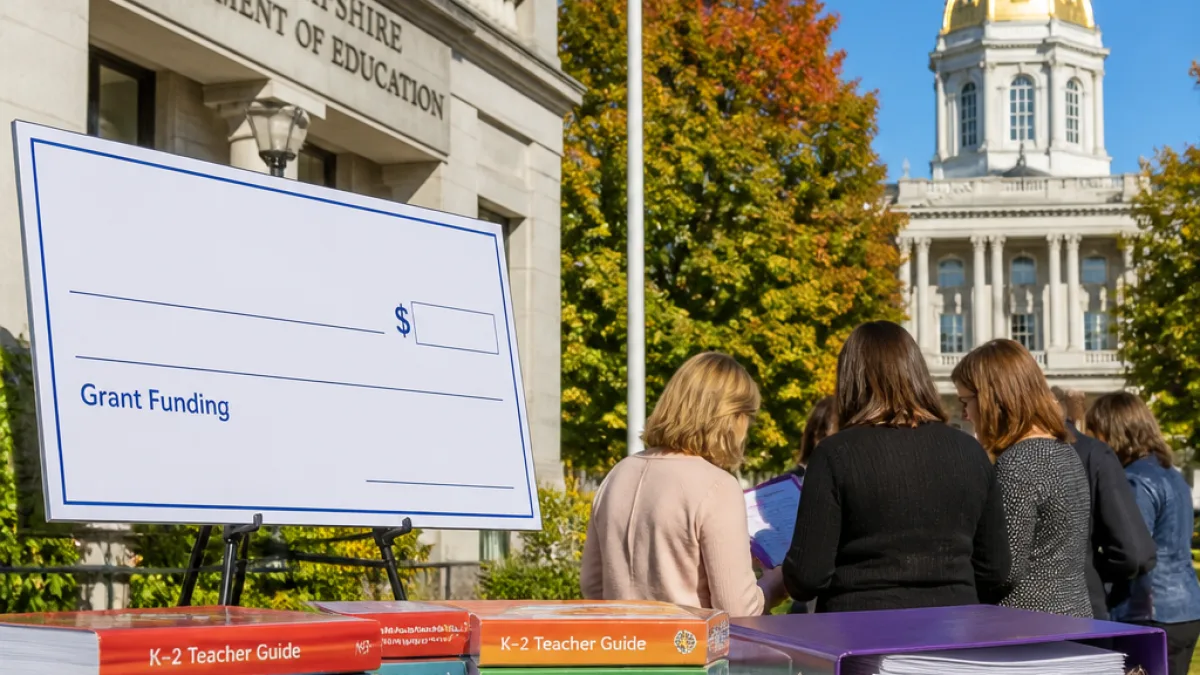
CONCORD — The New Hampshire Department of Education will use an $8.7 million federal award to push evidence-based writing instruction into elementary and middle schools across the state, officials announced Friday.
What the money will do
The grant, issued by the U.S. Department of Education, funds a five-year initiative aimed at strengthening classroom writing instruction for students in kindergarten through eighth grade. The department said the effort will supply intensive professional learning, classroom resources, coaching and implementation support tied to the Institute of Education Sciences’ What Works Clearinghouse recommendations.
The initial phase is set to reach about 100 schools and thousands of teachers and students, with a plan to expand by training local educators to train others — potentially adding up to 40 additional schools later in the grant period.
“This investment recognizes New Hampshire’s commitment to ensuring every student has access to high-quality, evidence-based instruction,” said Commissioner Caitlin D. Davis of the New Hampshire Department of Education.
How this links to state priorities
The project complements efforts announced by Gov. Kelly Ayotte in her 2026 State of the State address, when she called for raising literacy expectations and asked the education commissioner to lead a new reading initiative. Department officials said the grant will accelerate those goals by building students’ writing skills alongside reading-comprehension strategies.
The program will be led by NHED in partnership with a nationally recognized provider of evidence-based literacy professional learning. Implementation will roll out in phases through the 2026-27 school year and across the five-year period.
What districts and teachers will see
According to NHED’s announcement, participating districts can expect:
- Statewide professional learning focused on evidence-based writing instruction
- Classroom coaching and implementation support for teachers
- Instructional resources aligned to research-backed practices
The department said those supports are designed to be sustained after the grant ends by training teachers who can then serve as local trainers.
Numbers at a glance
| Item | Detail |
|---|---|
| Grant amount | $8.7 million |
| Duration | 5 years |
| Target grades | K–8 |
| Initial schools | ~100 |
| Potential additional schools | Up to 40 (train-the-trainer model) |
Why writing, and why now
New Hampshire’s education leaders framed the grant as a practical step toward boosting both writing and reading comprehension. Writing instruction is increasingly treated by researchers and state officials as a lever for broader academic gains: clear writing requires organization, vocabulary, and close reading — skills that transfer across subjects.
For districts, the grant arrives amid ongoing conversations about literacy standards and teacher training. Smaller rural districts and those with limited professional development budgets often struggle to access sustained coaching; federal funds like this are meant to offset those gaps and provide consistent, research-aligned supports.
Local impact and next steps
Districts interested in participating will join in phases during the grant period, the department said. Implementation is slated to begin in the 2026–27 school year, with NHED coordinating with a national partner to deliver training and coach support.
Exactly which schools will be in the first wave has not been released. District officials will likely weigh the opportunity against local timelines, staffing, and capacity to implement new practices.
The $8.7 million grant won’t rewrite classroom lessons overnight, but it does provide a structured path — training, resources and on-the-ground coaching — that districts say can move the needle when educators have the time and support to adopt evidence-based practices.
That kind of sustained support is the sort of thing teachers keep asking for. Whether it translates into measurable gains will depend on how faithfully schools implement the practices and how long that support continues after federal dollars dry up.
For parents and educators wanting more information, NHED is the point of contact as the department finalizes participating districts and the timeline for rollout.