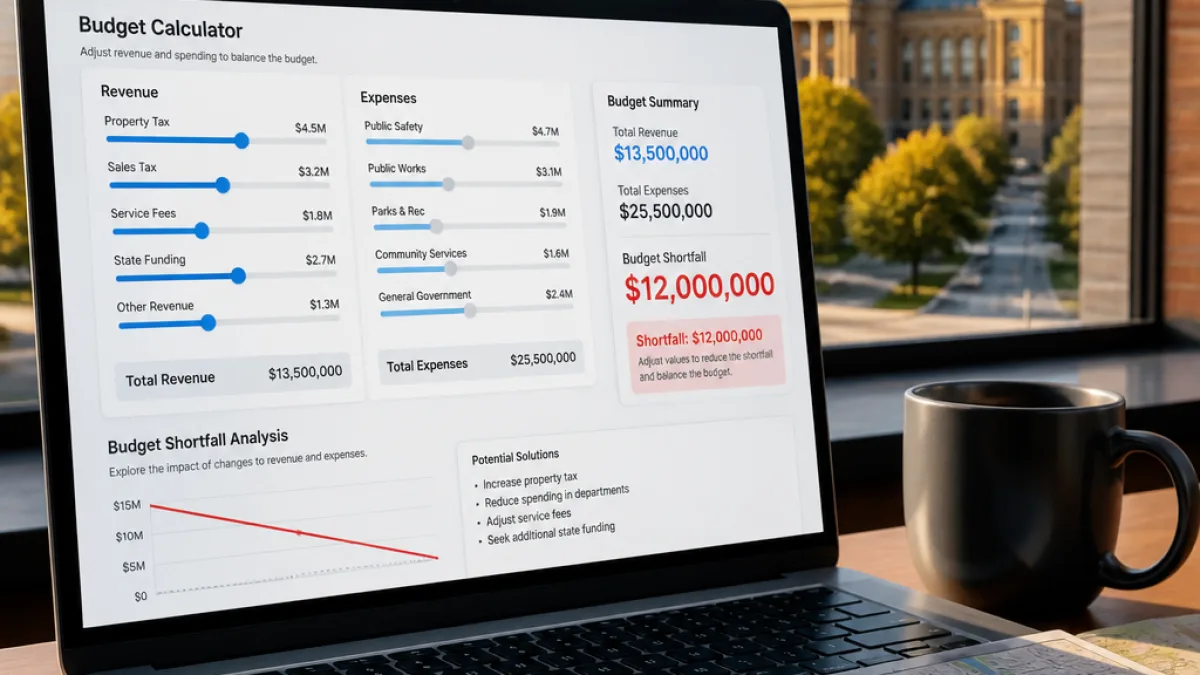
Des Moines residents who logged into the city’s online budget calculator this summer left a clear message about where they would trim if the city must close an anticipated shortfall: go after administrative overhead, fees and discretionary programs before cutting core public safety services.
How the public input was gathered
From late June through the end of July, 2,303 people completed an interactive exercise that asked them to prioritize potential savings and new revenue to help close an estimated $12 million shortfall the city faces in FY2028. The gap is the result of state property-tax legislation that the city says will significantly limit its revenue in coming budget years.
The calculator started with $6.4 million in pre-selected administrative reductions — cuts in units that primarily support other departments, including the City Clerk, City Manager’s Office, Finance, IT and Human Resources, plus a comprehensive review of existing city fees. Participants were then asked to choose an additional $5.6 million from a menu of 37 possible service reductions or new revenue options. Submissions that did not reach the full $12 million were treated as incomplete and were not included in the compiled results.
Top priorities and immediate implications
The responses show residents are willing to sacrifice certain programs rather than reduce police or fire services. Leading the list of items respondents favored cutting was the Floodplain Property Buyout Program — 88% of respondents indicated it should be the first item cut. Other widely supported choices were slowing site plan reviews (84%), creating resident/non-resident park fees (82%), ending the private property graffiti removal contract (81%), selling underused park land (80%) and adding new engineering fees (78%).
- Respondents: 2,303 completed submissions
- Budget gap: $12 million for FY2028
- Pre-selected administrative savings: $6.4 million
- Additional choices asked for: $5.6 million from 37 options
| Option | Share of respondents favoring cut |
|---|---|
| Floodplain Property Buyout Program | 88% |
| Slow site plan reviews | 84% |
| Resident/non-resident park fees | 82% |
| End private-property graffiti removal | 81% |
| Sell underused park land | 80% |
| Add new engineering fees | 78% |
“Many also supported eliminating services they viewed as duplicative,” the city summarized in its release outlining the survey results.
City officials plan to use the compiled feedback to shape budget recommendations that will be presented to the Des Moines City Council later this month. The input offers council members a sense of political tolerances and priorities from a self-selected sample of residents — useful context as staff weigh trade-offs and draft spending proposals.
What this means for neighbors at the kitchen table
For many Des Moines households, the choices on the list translate into changes that might be felt in different ways: a pause on some development reviews could slow new housing or business permits; new park fees could change routine weekend plans for families; selling underused parkland would reshape neighborhood green space over time; and ending contracted graffiti removal could shift cleanup responsibilities or response times.
The strong preference against trimming public safety services suggests residents value immediate protections over longer-term programs that reduce flood risk or expand amenities. Cutting the Floodplain Property Buyout Program, for example, would mean fewer voluntary acquisitions of homes in recurring flood zones — a move that could limit the city’s ability to reduce repeated disaster costs and individual homeowner risk in coming years.
Officials emphasize that the survey is one part of a larger budgeting process. Staff are now reviewing the public’s selections alongside financial models, statutory constraints and service-level impacts to produce formal recommendations the council will consider. Those decisions will determine whether the city leans more heavily on fee increases, program reductions, asset sales or a combination of strategies to balance the budget.
Residents who did not participate have other opportunities to weigh in as the council examines proposed changes; the coming weeks will include public meetings and hearings where the consequences of each option will become clearer.