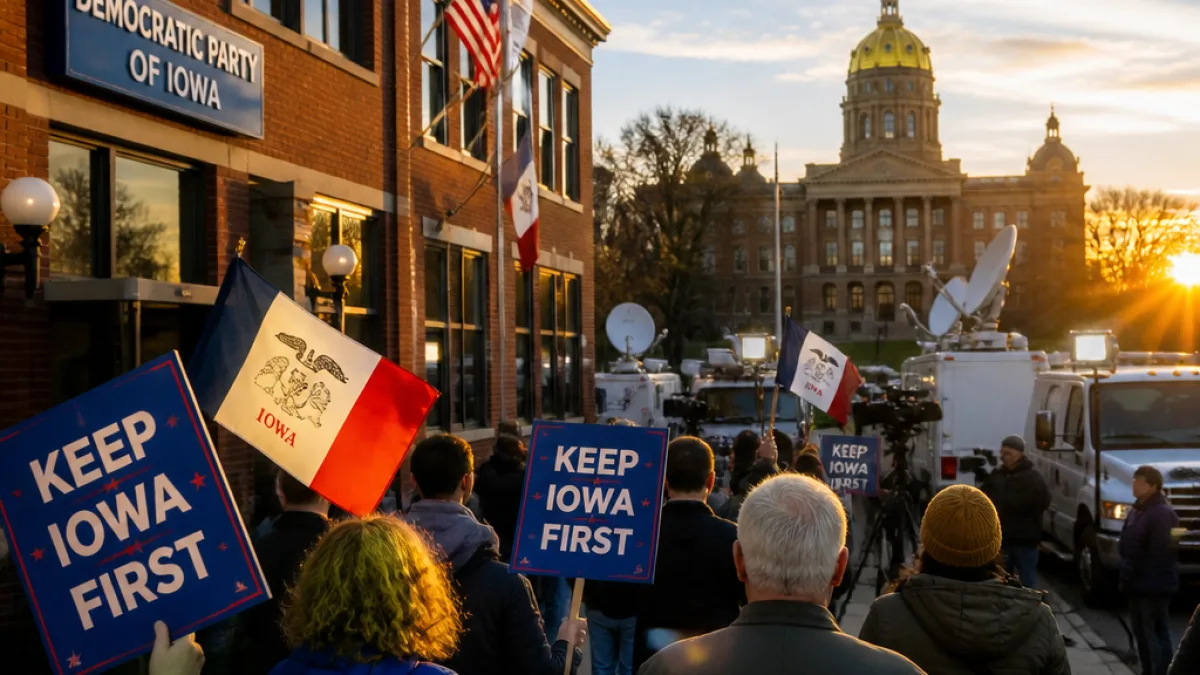
DES MOINES — The Democratic National Convention on Friday formally moved Iowa out of its longstanding role as the first-in-the-nation presidential caucus state, ending a 54-year run that has been a fixture of the presidential nominating calendar for multiple generations of Iowans.
The change puts South Carolina at the front of the 2028 early window for Democrats, with a sequence that will include New Hampshire, Nevada, New Mexico, Michigan and Virginia following it, according to party officials.
Local leaders push back, vow to stay engaged
Iowa Democratic Party Chair Rita Hart told reporters she remains committed to keeping Iowa’s voices in the process despite the national party’s decision. She said the state party will seek constructive engagement with the new schedule.
"We intend to work with this new generation of leaders to ensure that Iowans' voices are heard in 2028,"
On the Republican side, Iowa GOP Chair Jeff Kaufmann voiced sharp disappointment, calling the move disrespectful to the state. Kaufmann and other critics suggested the decision was politically motivated rather than solely based on logistics.
"Am I irritated with this? You better believe it. My state has been disrespected," Kaufmann said, according to published remarks.
Why the change? Party officials cite past problems and diversity aims
Democrats pointed to the troubled 2020 Iowa caucuses — where precincts reported results very late amid technical failures — as a contributing factor in the party's reevaluation of the early-state lineup. In addition, the national party has emphasized making the early window more reflective of the party’s demographic diversity.
Some academics and local political figures framed the decision more directly through an electoral lens. Iowa State University political analyst Karen Kedrowski noted that the party's stated aim of elevating states with higher minority populations likely influenced the decision to move South Carolina to the front.
"They're saying that they want to have states that are competitive go early, but South Carolina is solidly red and is not competitive," Kedrowski said. "So I think that really is something to say about appealing to Black voters."
Local frustration and legal limits
The decision was met with frustration from some in Iowa’s party establishment. Former Iowa Democratic Party chair and state Representative Ross Wilburn criticized the move for sidelining the Midwest in a process he argued should build sustainable majorities by investing in the region.
Wilburn said he feared the shift could leave the Midwest — and Iowa specifically — behind in national Democratic calculations. "If we want to build lasting sustainable majorities that enact real change, Democrats need to invest in Iowa and the Midwest, not leave us behind like they did today," he said.
The change also raises questions about state law. Iowa Code 43.4 has language requiring Iowa to hold the first caucuses and primaries in the nation, a statute that could complicate any attempt by state officials to comply with the national party’s calendar.
What the new early-state window looks like
Party leaders laid out the sequence of early states that will shape the 2028 Democratic nominating calendar. The order shifts both symbolic and practical campaigning dynamics away from Iowa.
- First: South Carolina
- New Hampshire
- Nevada
- New Mexico
- Michigan
- Virginia
| Aspect | Impact |
|---|---|
| Political influence | Iowa loses early leverage over candidate momentum and attention |
| Campaign spending | Likely to shift toward states earlier in the new window |
| State law | Iowa Code 43.4 may conflict with party scheduling |
What happens next
State party leaders now face the dual challenge of engaging with the national party’s new timetable while also addressing concerns inside Iowa about diminished influence. The move is likely to ignite debate in the statehouse and among local political activists about how to preserve Iowa’s voice in future presidential cycles.
For Iowa voters and officials, the practical consequences will unfold in how campaigns allocate time, money and attention during the next presidential cycle. For now, the decision marks a sharp break with half a century of tradition and places the state on a different footing in national Democratic politics.
As the dust settles, party officials in Iowa will have to balance outreach to the national party with efforts to reassure Iowans that their concerns and communities will remain central to the democratic process, regardless of calendar placement.
— Reporting from Des Moines.