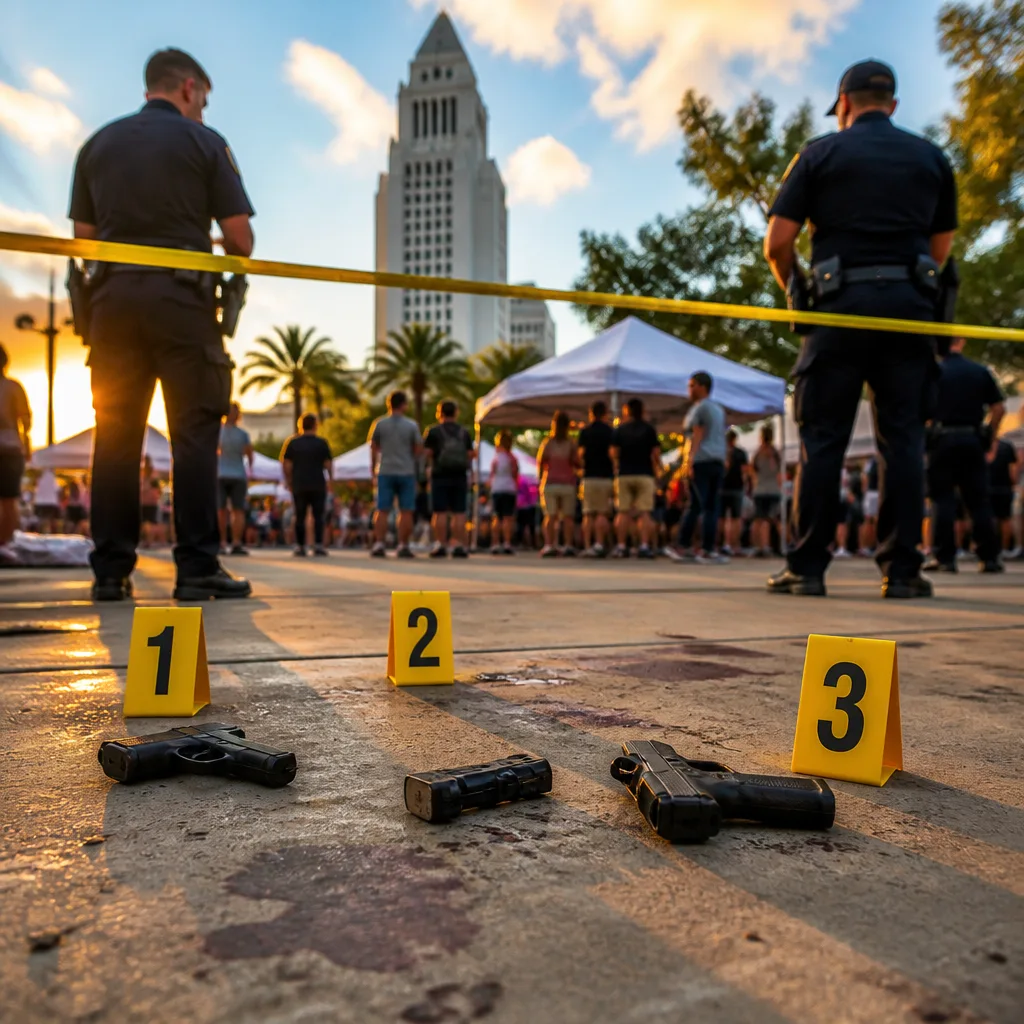
Seattle police said investigators recovered a modified machine gun and an untraceable "ghost gun" at the scene of a mass shooting that erupted Sunday during a three-day food festival at Seattle Center and left three people dead and at least five more wounded.
“Sunday’s shooting appeared to involve at least three suspects,” Seattle Police Chief Shon Barnes said at a televised news conference.
Officials describe chaotic scene
Authorities said one of the three suspected shooters, 19-year-old Junior Cee Niko Semo, died at the scene. A second suspect, a 15-year-old, was disarmed and taken into custody at the festival. Police said at least one additional suspect remained at large as investigators worked to piece together what led to the outbreak of gunfire in a crowded public park near the Space Needle.
The two victims whom police say were uninvolved in the shooting were identified as Carlos Israel Sanchez Villalba, 44, and Ashley Whitehead, 56. Among those struck by gunfire was a two-year-old boy, and others were injured while fleeing as the crowd surged to escape the violence.
Weapons recovered
Officers recovered casings and three pistols at the scene. Two of those firearms raised particular concern for investigators and the public:
- A 9mm ghost gun assembled from a parts kit made by the now-defunct company Polymer80, seized from the 15-year-old suspect.
- A Glock pistol modified with an auto sear (commonly called a "switch"), which allows it to be fired as a fully automatic weapon; that Glock had an extended magazine holding 40 rounds.
Police said the ghost gun had an extended magazine with 33 rounds. The third recovered firearm, a .45-caliber pistol, was not used in the crime, according to authorities. Washington state law generally limits magazines to 10 rounds.
| Recovered weapon | Magazine capacity | Notes |
|---|---|---|
| Glock with auto sear | 40 rounds | Modified to fire fully automatically |
| 9mm Polymer80 ghost gun | 33 rounds | Assembled from parts kit; untraceable |
| .45-caliber pistol | — | Not used in the shooting |
National implications and enforcement challenges
Law enforcement officials have increasingly warned about two overlapping trends that surfaced again in Seattle: the growing presence of ghost guns—firearms made from kits or unserialized parts that evade traditional tracing—and cheap add-on devices that convert semiautomatic pistols into weapons capable of sustained automatic fire. Both complicate investigative work and raise questions about how state and federal rules can keep pace.
Police said they did not believe any of the recovered firearms had been stolen, though they were still tracing the two serialized guns found at the scene. The combination of high-capacity magazines and devices that increase a gun’s rate of fire can amplify casualties, investigators warned, while ghost guns make it harder to trace ownership and prior use.
Ongoing investigation
Detectives continue to interview witnesses, review surveillance and social-media posts, and follow leads to locate any additional suspects and to determine motive. Officials have characterized the incident as involving multiple shooters and crossfire that struck bystanders.
The arrests and weapons recovered in Seattle will almost certainly be cited in national debates over gun regulations, including proposals to restrict ghost-gun kits, ban devices that convert semiautomatic weapons to fully automatic, and tighten magazine-capacity limits. For now, investigators must focus on identifying any remaining suspects and building evidence for prosecution while the city grapples with the immediate human cost of the attack.
As the community processes the violence at a festival that attracts families and tourists, law enforcement emphasized the hazards posed by weapons that are increasingly easy to obtain or to modify, and the challenges they present to public safety.