
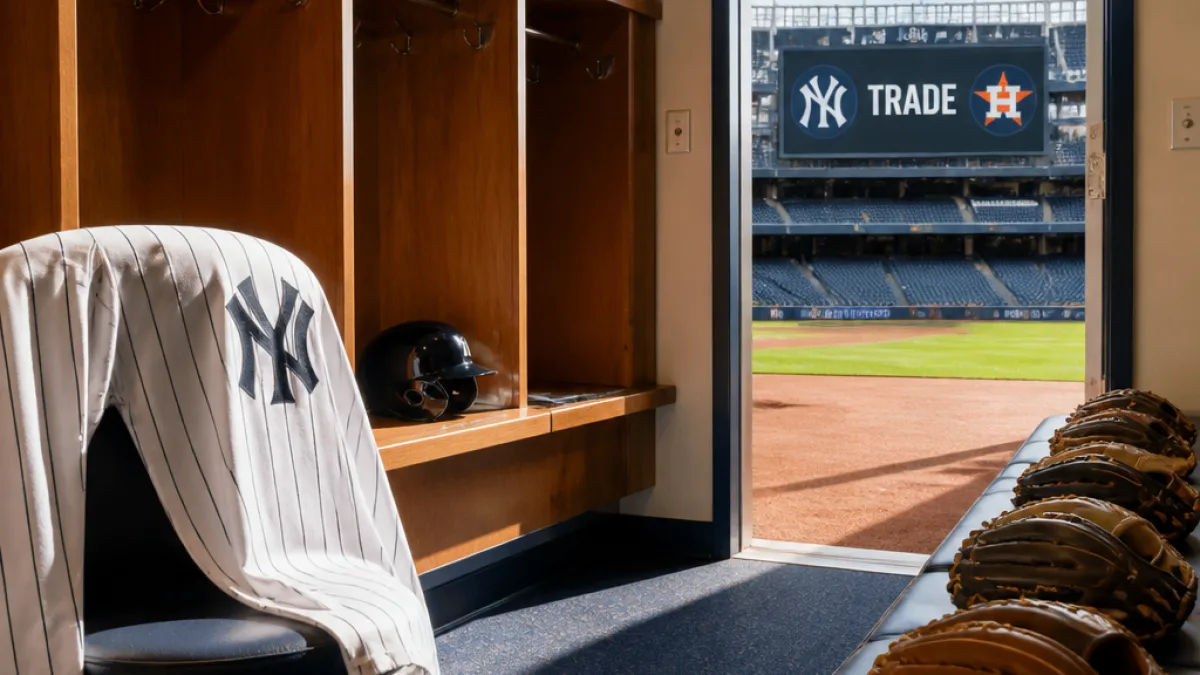
The New York Yankees on Sunday acquired infielder Luis Garcia Jr. from the Washington Nationals in exchange for four right-handed pitchers, a move the club described as an effort to jump-start an offense dealing with significant injuries.
Trade details and immediate context
The Nationals will receive pitchers Yovanny Cruz, Jake Bird, Ben Grable and Jack Cebert in the deal, the teams announced. Garcia, 26, is under club control through next season and arrives in New York leading the National League in slugging percentage.
Garcia’s numbers this year include a .283 batting average, a career-high 23 home runs, a .560 slugging percentage, an .873 OPS and a 134 wRC+ across 104 games. The acquisition is intended to provide a run-producing presence as the Yankees contend with the prolonged absences of key hitters Aaron Judge, Cody Bellinger and Giancarlo Stanton.
"He rakes," Yankees manager Aaron Boone said of Garcia upon hearing of the trade.
Teammates expressed approval as well. Pitcher Gerrit Cole called the move evidence of the organization’s commitment to improvement, saying the Yankees’ approach is “one of the blessings about playing for the Yankees.”
Fit and lineup implications
While Garcia’s bat will be welcomed, his arrival presents lineup and defensive juggling for the Yankees. Garcia is a left-handed hitter who has played primarily at second base through his first six major league seasons before spending much of this season at first base.
New York already employs Ben Rice and Paul Goldschmidt sharing time between first base and designated hitter roles, and Jazz Chisholm Jr. is the regular at second base. How the Yankees deploy Garcia will depend on matchups and manager Aaron Boone’s immediate needs, with options including first base and the designated hitter spot against right-handed pitching.
- Primary need filled: middle-of-order, run production
- Defensive versatility: experience at second and first base
- Control: under club control through the 2027 season
What the numbers say
Garcia’s 2026 season represents a breakout in power and on-base production. His 134 wRC+ indicates he produced 34% more offensive value than the average major leaguer. That combination of power and efficiency is exactly what the Yankees have sought as they try to compensate for absent lineup staples.
| Stat | 2026 |
|---|---|
| Batting average | .283 |
| Home runs | 23 |
| Slugging percentage | .560 |
| OPS | .873 |
| wRC+ | 134 |
Roster questions and Yankees’ strategy
The trade underscores the Yankees’ willingness to part with pitching depth to augment an offense that has underperformed relative to expectations. The quartet of pitchers sent to Washington are right-handers — a package that reflects the Yankees’ calculation about their organizational depth and immediate win-now posture.
Manager Boone and the front office face a roster puzzle: integrating a left-handed slug into a lineup that has sought right-handed pop. The Yankees could rotate Garcia into the lineup based on matchups while preserving flexibility at first base and DH spots.
Outlook and immediate impact
Garcia’s presence gives New York an additional middle-of-order bat during a critical stretch in August. Whether he immediately changes the team’s offensive fortunes will depend on how quickly the Yankees find a regular role for him and how he adjusts to the American League East’s pitching mix.
For the Nationals, the return of four pitching prospects reflects a continuing rebuild strategy. For New York fans, the trade is a clear signal: the franchise is spending depth to shore up an offense that still hopes to contend this season despite significant injuries.
At a time when roster moves attract magnified scrutiny, the acquisition will be judged by results — runs driven in, games won and how the Yankees fare during an August that may define their season.