NEW YORK — A federal judge on Monday paused New York’s effort to require immigration agents to show their faces while on duty, finding the federal government likely to prevail on constitutional grounds even as the court allowed the state’s ban on certain cooperation agreements with U.S. Immigration and Customs Enforcement to stand.
What the court decided
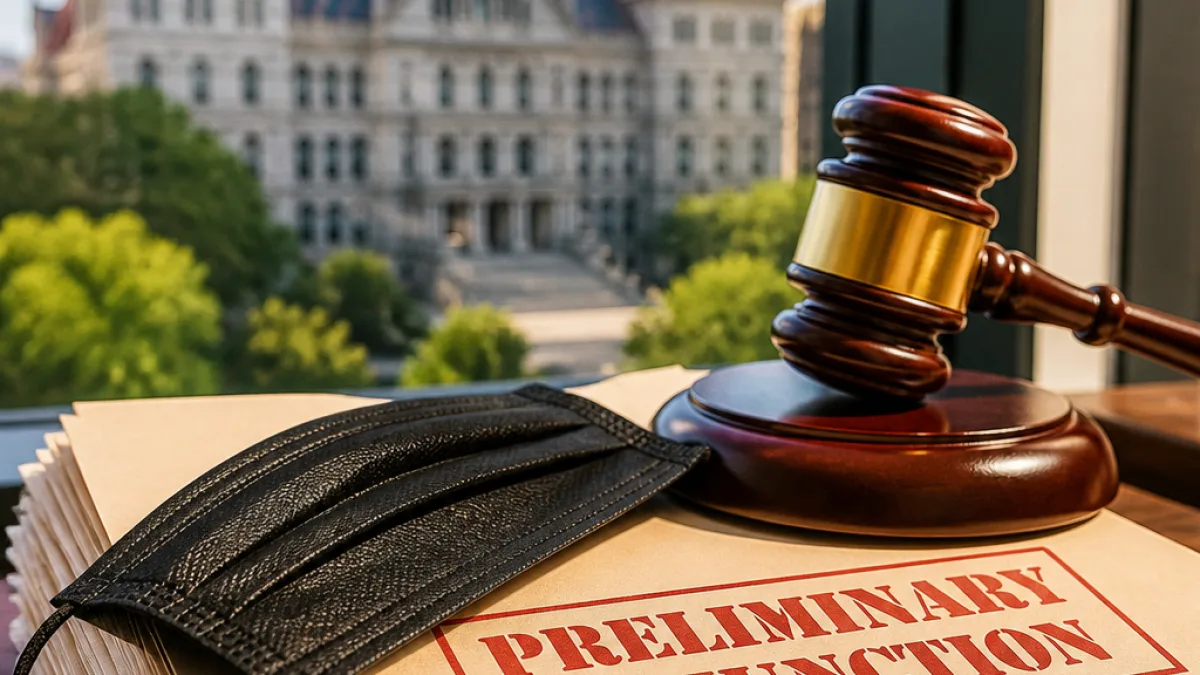
U.S. District Judge Mae D’Agostino issued a preliminary injunction that prevents state officials from enforcing the provision of a newly enacted law that would bar federal officers, including immigration agents, from wearing masks while performing duties in the state. At the same time, D’Agostino left intact a separate portion of the law that prohibits local police departments from entering into 287(g) cooperation agreements with ICE, a program that deputizes local officers to carry out certain federal immigration tasks.
The mixed ruling frames a narrower legal victory for New York and a broader vindication for the Justice Department’s challenge to the mask restriction. D’Agostino wrote that the federal government had shown a likelihood of success on its claim that New York’s facial-covering ban directly regulates federal officers in a way that conflicts with the Supremacy Clause.
State officials respond
"Local law enforcement should be focused on local matters, and New York taxpayers should not have to foot the bill for any collaboration with ICE,"
Gov. Kathy Hochul and Attorney General Letitia James issued a joint statement after the ruling, arguing that the portion of the law blocking 287(g) partnerships remains lawful and important to community safety. They said their offices are reviewing legal options regarding the facial-covering injunction.
The statement emphasized the administration’s view that masked agents do not make communities safer, and framed the 287(g) ban as a fiscal and public-safety measure.
Legal and political stakes
The ruling touches on two fault lines: constitutional limits on state measures that affect federal actors, and state authority to regulate how local governments cooperate with federal agencies. The decision follows similar rulings in other federal courts that have struck down local or state measures limiting face coverings by federal officers.
Supporters of New York’s restrictions pushed them in response to what state Democrats described as aggressive immigration tactics by ICE. Backers argued the law helps preserve local trust with immigrant communities and prevents local resources from being diverted to federal immigration enforcement. Opponents, including Republicans and the federal government, say such measures interfere with federal immigration policy and jeopardize public safety.
Immediate consequences
Because the injunction is preliminary, the mask ban cannot be enforced while the litigation continues. However, the survival of the 287(g) prohibition means local police departments in New York cannot lawfully enter new cooperation agreements with ICE under the statute as written.
- Mask ban: Enforcement paused by preliminary injunction.
- 287(g) ban: Remains in effect following the ruling.
- Next steps: State officials said they will review legal options; the Justice Department may move forward to litigate the merits.
Why it matters locally
For New Yorkers, the case has practical implications for how immigration enforcement is conducted on city streets, in courthouses and during community policing. The 287(g) program previously allowed some local agencies to perform limited immigration functions; its prohibition limits one avenue of federal-local cooperation and signals the state’s intent to insulate local policing from federal immigration priorities.
The injunction against the mask rule also raises operational questions for federal agents who may rely on facial coverings for safety or operational security. The court’s determination that the mask restriction likely runs afoul of federal supremacy sets up a broader constitutional confrontation that will play out in the coming months.
| Issue | Current status |
|---|---|
| Face-covering prohibition for federal agents | Temporarily blocked by preliminary injunction |
| Ban on 287(g) cooperation agreements | Remains in effect |
The ruling is likely to intensify political arguments over immigration in New York, with state Democrats framing their measures as protections for immigrant communities and Republicans and federal officials arguing the state is overreaching. Legal analysts say the case will test the limits of state power when it intersects with federal law enforcement.
As the litigation proceeds, practical realities on the ground are already shifting: local departments must navigate a legal landscape where some state restrictions are enforceable and others have been paused, and immigrant communities and advocacy groups will be watching for further developments.
This is a developing story; state and federal offices have indicated continued legal engagement but have not released further specifics on next steps at the time of the ruling.