
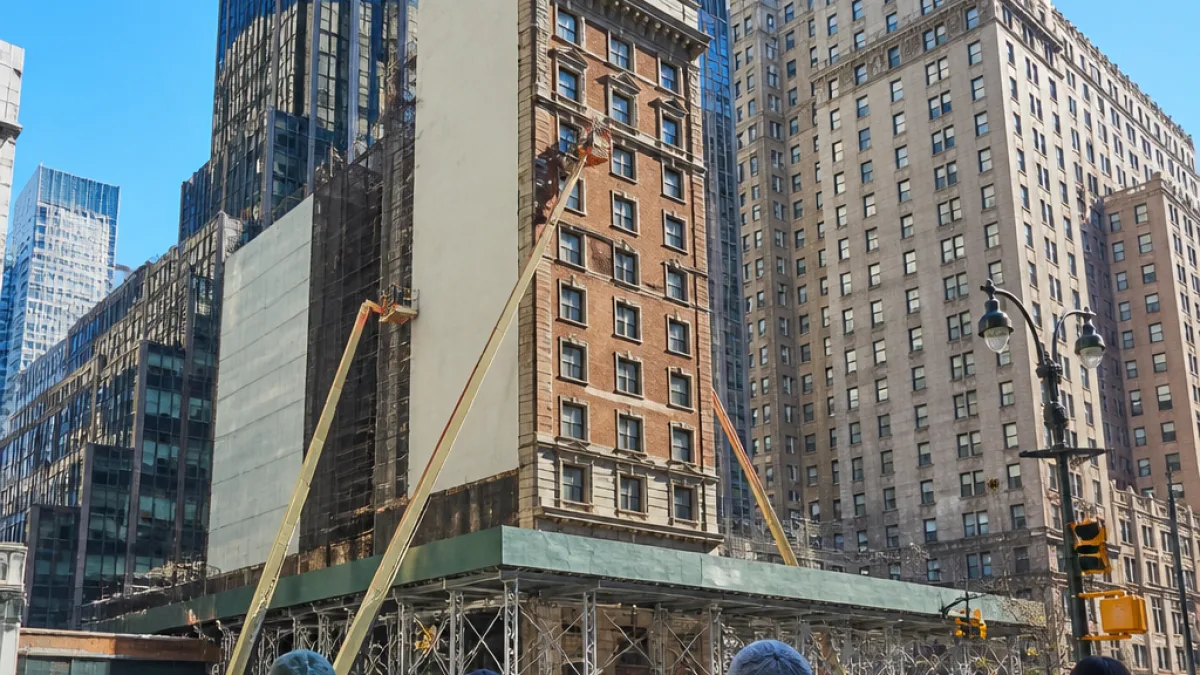
The familiar sight that greeted millions of Midtown pedestrians and tourists for decades — a giant red Macy’s shopping bag with white tissue paper peeking above the handles — has been removed from the department store’s Herald Square flagship, leaving a conspicuous blank on the corner of West 34th Street and Broadway.
The sign had stood in some form on that corner since at least the 1950s, according to an examination of Getty Images, and the red bag itself has been a fixture since the early 1990s. Its removal this month has revealed an older, smaller building that had been largely concealed by the massive billboard for generations.
What was revealed and why it matters
City observers and longtime visitors noted how odd the intersection looks without the oversized decorative bag. The exposed structure is a remnant of a property that held out when Macy’s was built around the turn of the 20th century, according to archival references. Originally only a single floor, the holdout later stood behind the succession of signs that turned the corner into an advertising landmark.
Dan Biederman, president of the 34th Street Partnership, said the sign came down because of a disagreement between property interests. “One firm owns the building and the other wants to keep an advertising sign up on it. They have to make an agreement and evidently that didn’t happen,” he said. “We don't know the details of either side and we love both sides so we're hoping that something good comes out of this.”
“For generations, the iconic sign at Macy's Herald Square has been a recognizable part of the 34th St. experience and a symbol of our deep roots in New York City... Soon, Macy's will announce refreshed and dynamic branding for Macy's Herald Square that honors our heritage while reflecting the future of our flagship.”
The lines above are from a Macy’s statement, which framed the change as part of a modernization effort by the billboard owner and suggested new branding would be unveiled in the future. The company did not specify what will replace the bag.
Brief timeline of the corner’s signage
| Era | Signage notes |
|---|---|
| 1950s | Massive signs present; Getty images show prominent advertising |
| 1992 | White sign with red outlines declaring “The World's Largest Store” |
| By 1994 | Early iteration of the red shopping bag appears |
| 2026 | Red bag removed amid reported real estate disagreement |
Neighborhood and cultural impact
Herald Square is more than an intersection; it's a commercial and tourist hub anchored by Macy’s. The red bag became a visual shorthand for the store’s holiday displays, sales and New York identity. Its sudden absence matters to residents, retailers and the flow of tourists who use such landmarks to navigate Midtown.
For decades the sign functioned as both advertising and civic ornament. Its disappearance leaves practical questions — who owns the newly exposed façade, what will be permitted there, and whether any replacement will aim to be as distinctive — and symbolic ones about change in urban appearance.
What officials and Macy’s have said — and what hasn’t been said
- 34th Street Partnership identified a property dispute as the proximate cause but did not provide contract details.
- Macy’s confirmed the sign was removed as part of billboard-owner modernization and promised refreshed branding but offered no timeline or design specifics.
- No public statements were provided by the property owners directly explaining the impasse.
The lack of concrete information has fed speculation among tourists and locals. Some mourn the loss of a familiar city icon. Others view the removal as one small sign of the broader evolution of Midtown retail and advertising — where static billboards give way to digital displays or different uses entirely.
For now, the corner sits exposed and quiet. Any replacement will be read not just as an ad but as a signal: whether Macy’s chooses a modern, dynamic face for its flagship or whether the space will revert to a more conventional façade. Macy’s language about honoring its heritage suggests the company is conscious of the cultural weight of the site, even as market and landlord mechanics seem to have precipitated this moment.
As negotiations and planning continue — between landlords, billboard owners, and Macy’s — commuters and sightseers will likely keep checking West 34th and Broadway. The absence of the red bag, at least temporarily, has made a familiar part of Midtown conspicuously visible again.