New York City health officials have issued a temporary swimming advisory for 18 beaches across the five boroughs after recent water samples showed elevated bacteria levels, the New York City Department of Health said Monday.
Scope and locations
The advisory affects several public and private swimming spots in Brooklyn, Queens, Staten Island and the Bronx. Among those named are high-traffic public beaches such as Coney Island and Manhattan Beach in Brooklyn, as well as multiple private and civic association beaches in the Bronx and Queens.
The full list of beaches currently operating under the city’s water-quality advisory includes:
- Cedar Grove Beach (Staten Island)
- Coney Island (Brooklyn)
- Manhattan Beach (Brooklyn)
- Midland Beach (Staten Island)
- South Beach (Staten Island)
- American Turner (private, Bronx)
- Danish American Beach Club (private, Bronx)
- Douglaston Manor (Queens)
- Gerritsen/Kiddie Beach (Brooklyn)
- Kingsborough Community College (private beach, Brooklyn)
- Morris Yacht Club (private, Bronx)
- Schuyler Hill Civic Association (private, Throgs Neck, Bronx)
- Sea Gate 42nd Street (private, Brooklyn)
- The Strand (private, Bronx)
- Trinity Danish Swimming Club (private, Bronx)
- West Fordham Street Association (Bronx)
- White Cross Fishing Club (Bronx)
- Whitestone Booster Civic Association (private, Queens)
How the city monitors water quality
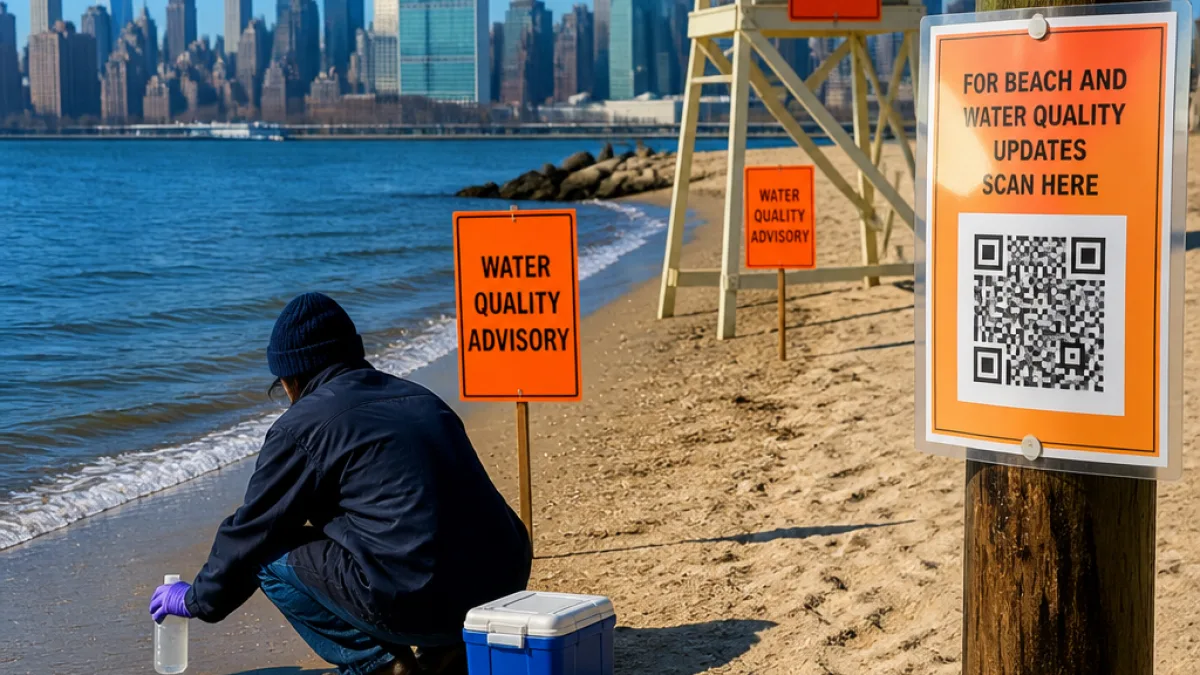
The Department of Health samples beach water once or twice a week during the swimming season, which runs from June through September. Officials test for bacterial indicators — specifically enterococci and E. coli — that can suggest contamination from fecal pollution.
Water quality is presented as a most probable number (MPN) per 100 milliliters, a statistical estimate of bacterial concentration in a sample. New York State standards use these tests to decide when conditions present a potential public-health risk.
Public guidance and implications
An advisory signals elevated bacteria readings but is not the same as a closure. Bathers are generally warned that swimming could increase the risk of gastrointestinal, skin or ear infections, particularly for children, pregnant people and those with weakened immune systems. The city posts advisories to inform residents while it continues sampling and investigates potential pollution sources.
Advisories also carry practical implications for beach operations. Lifeguard staffing and public programming may continue, but officials encourage people to avoid contact with the water where possible until readings return to acceptable levels.
Where to look for updates
The Department of Health updates beach advisories based on subsequent samples and environmental conditions such as heavy rain, which can raise bacteria levels by flushing runoff into bathing waters. Beachgoers can consult the city’s official beach-condition webpages or local signage at each site for the latest status.
| Measure | What it indicates |
|---|---|
| Enterococci / E. coli | Indicators of fecal contamination |
| MPN/100 mL | Estimated bacteria concentration used to assess water safety |
The current advisory underscores the patchwork nature of urban water quality: the list includes heavily used public beaches and smaller private or civic-club sites. Public-health officials say the routine sampling schedule is designed to catch problems quickly and provide timely information to the public.
City residents planning beach trips this week should check individual beach postings before entering the water, especially if recent storms or localized runoff might have affected conditions.