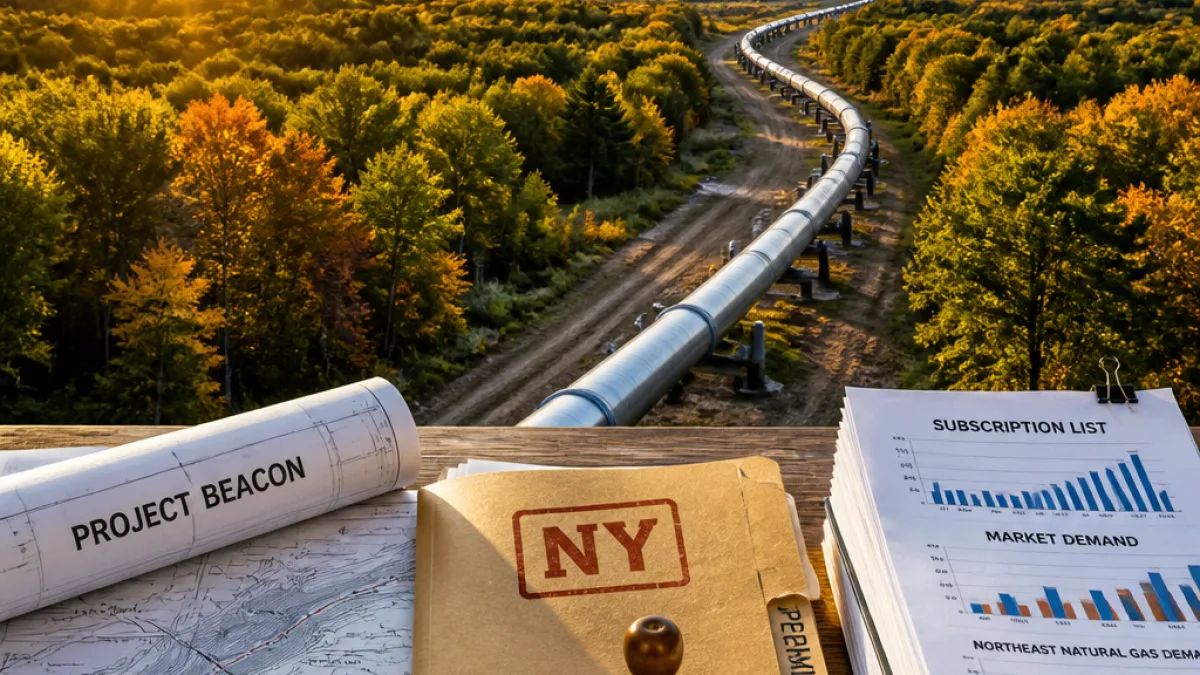
Enbridge told investors last week that an open season for Project Beacon, a proposal to boost capacity on the Algonquin Gas Transmission system by roughly 10 percent, drew significantly more interest than the company had expected. The enthusiasm, company leaders said, has prompted work toward binding customer commitments even as regulatory approvals — particularly in New York — loom as the decisive obstacle.
Commercial demand, regulatory uncertainty
Speaking on Enbridge’s second-quarter earnings call, CEO Greg Ebel described the response to the mid-May through early-July solicitation as “significantly exceeded” expectations and indicated the company is already engaging with utilities, power generators and data centers to convert that interest into firm contracts. Enbridge positioned the effort as a needed expansion to meet rising demand in the Northeast.
“We’re working with utility, power and data center customers to advance the project to binding commitments, while also progressing permitting activities, and we’ll share further updates later in the year,” said Ebel.
Still, executives were quick to stress that the project is not yet sanctioned and that approval timelines — especially permits in New York — will determine whether Beacon advances. Matthew Akman, an Enbridge executive vice president, told analysts the principal risk is permitting and that the company would “maintain our discipline” in assessing that risk.
Why New York matters
For developers seeking to move more natural gas into New England, New York has become the pivotal regulatory battleground. The Algonquin corridor already traverses parts of the state, and Beacon is expected to remain within existing rights-of-way. But any expansion that increases throughput typically triggers state and local environmental reviews, public hearings and potential legal challenges.
That dynamic has intensified under the current federal administration, which industry officials say has opened the door to new projects to shore up regional supply. At the same time, several Democratic governors in the Northeast have signaled pragmatic concerns about energy costs and the power needs of major electricity customers such as data centers.
Other pipeline proposals could gain momentum
Enbridge’s open season appeared to reverberate across the industry. DT Midstream executives, on their own earnings call last week, suggested the market interest tied to Beacon could help revive discussions on expansions of other regional systems — including a concept tied to the Millennium pipeline chain of facilities that the company has discussed publicly.
- Project: Beacon — Enbridge proposal to expand the Algonquin system.
- Capacity change: approximately 10 percent increase, per company statements.
- Primary hurdle: permits in New York, according to Enbridge executives.
What the timeline looks like
Enbridge did not announce a firm sanction date. Executives said the open season results will feed into discussions to secure binding commitments from shippers, while permitting work continues. The company indicated it would provide further updates later in the year as those processes develop.
| Item | Status |
|---|---|
| Open season | Closed; company says interest exceeded expectations |
| Customer commitments | In progress — moving toward binding contracts |
| Permitting | Ongoing; New York permitting cited as main risk |
| Final sanction | Not yet determined |
Local implications
For New Yorkers, the debate over Beacon is not only about fuel for New England. It intersects with longstanding concerns about environmental impact, the role of fossil fuels in decarbonization plans and the balance between energy reliability and community rights. Projects that remain inside established corridors can reduce some construction impacts, but they still prompt state reviews of emissions, pipeline safety and cumulative effects.
Municipalities and environmental groups that have opposed past pipeline expansions in the state will likely scrutinize permit applications closely. At the same time, utilities and large electricity consumers in the region argue that more pipeline capacity can alleviate price volatility and support operations that require steady power.
What to watch next
Key near-term developments will include whether and when Enbridge secures binding shipper commitments and how state regulators in New York respond to any permit applications tied to Beacon. Industry participants also said they will be watching parallel moves from competitors and partners, which could reshape the economics of regional expansions.
Enbridge’s comments make clear the project has commercial momentum. Whether that momentum survives the regulatory gauntlet in New York will determine if Beacon ever moves from proposal to construction.