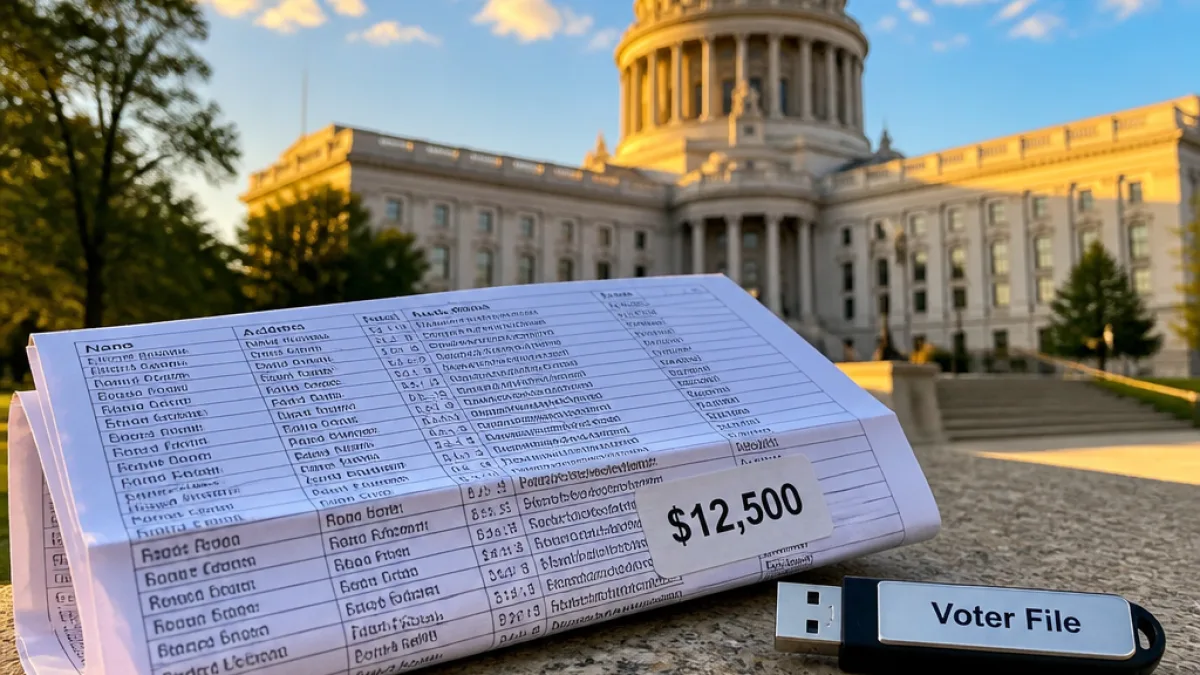
The Wisconsin Elections Commission makes the statewide voter file available to the public for a one-time fee of $12,500, a practice that has drawn renewed attention after national claims about foreign access to voter data.
What the file contains — and what it doesn’t
Under the state’s rules and guidance from the Wisconsin Legislative Council, the voter list sold by the commission includes basic identifying information and a voter’s participation record in recent elections. The file does not, however, contain other sensitive identifiers.
| Included | Excluded |
|---|---|
| Names | Date of birth |
| Addresses | Driver’s license number |
| Whether a person voted in recent elections | Social Security number |
That voting history — a dry little column that tells whether someone showed up at the polls — is part of why campaigns, advocacy groups and media routinely obtain voter files. The information helps organizers target outreach, verify participation and do basic research on turnout.
Who can buy the file and what they can do with it
State guidance is blunt: once purchased, the voter data may be used “to contact individuals for any purpose.” In plain terms, Wisconsin law does not impose limits on commercial or political uses of the voter list after a buyer pays the fee.
- Any individual or organization can request the file for the stated fee.
- There are no statutory restrictions on how a buyer uses the data once obtained.
- Data purchasers may include domestic campaigns, parties, advocacy groups and foreign entities, unless federal law or other rules apply.
That openness prompted questions in the wake of a July 16 speech by former President Donald Trump in which he said voter data had been “bought, stolen or hacked by China” in multiple states following the 2020 election. The assertion has been part of a broader national debate about whether public voter records are vulnerable to foreign actors.
“bought, stolen or hacked by China”
Security, hacking claims and Wisconsin’s record
Wisconsin election officials say the state’s election systems are secure. Unlike some of the claims circulating online, the Wisconsin voter list available from the state is not known to have been hacked. A prior federal statement also concluded that Russia did not seek to hack Wisconsin's election systems.
Still, there’s a difference between systems that administer voting — tabulators, voter registration databases maintained by state and local clerks — and the public voter file, which is intentionally a public record under state law. That legal status is what allows the commission to charge a fee and distribute the file.
Why people care — and what this means locally
For campaigns and civic groups, the voter file is a tool. For privacy advocates and many voters, the idea that a foreign government could purchase a dataset with names, addresses and voting histories is unsettling. The legal tension is straightforward: public-record laws favor transparency and access, while privacy concerns push for limits on distribution and use.
In practical terms for Wisconsin residents: the file lacks the most sensitive personal identifiers that make identity theft straightforward, but it does reveal where people live and whether they voted. That information can be used for legitimate outreach or for targeted messaging by actors whose intentions may be unknown.
What voters can do
There is no mechanism under current state law to opt out of the public voter file entirely. Voters who are concerned about privacy may consider these steps:
- Confirm registration details with your municipal clerk to ensure records are accurate.
- Sign up for election notices from your local clerk rather than relying on mass outreach sources.
- Stay informed about legislative proposals; changes to public-record rules would need to be passed by the Legislature.
For now, the state’s position is simple: the voter file is public, the Elections Commission will sell it for the published fee, and officials say election infrastructure has not been compromised. Whether that balance between openness and privacy will satisfy voters — or lawmakers — remains an open question as national debate continues.
This report draws on state guidance from the Wisconsin Legislative Council and public statements from the Wisconsin Elections Commission, and reflects reporting developed in collaboration with local news partners examining the issue of public voter information.