The Escondido City Council voted unanimously July 29 to adopt new safety guidelines for battery energy storage systems (BESS), ending a moratorium that had been in place since the 2024 Otay Mesa and San Diego Gas & Electric fires prompted widespread concern about large lithium-ion storage facilities.
Minimum safety features set; setbacks can grow
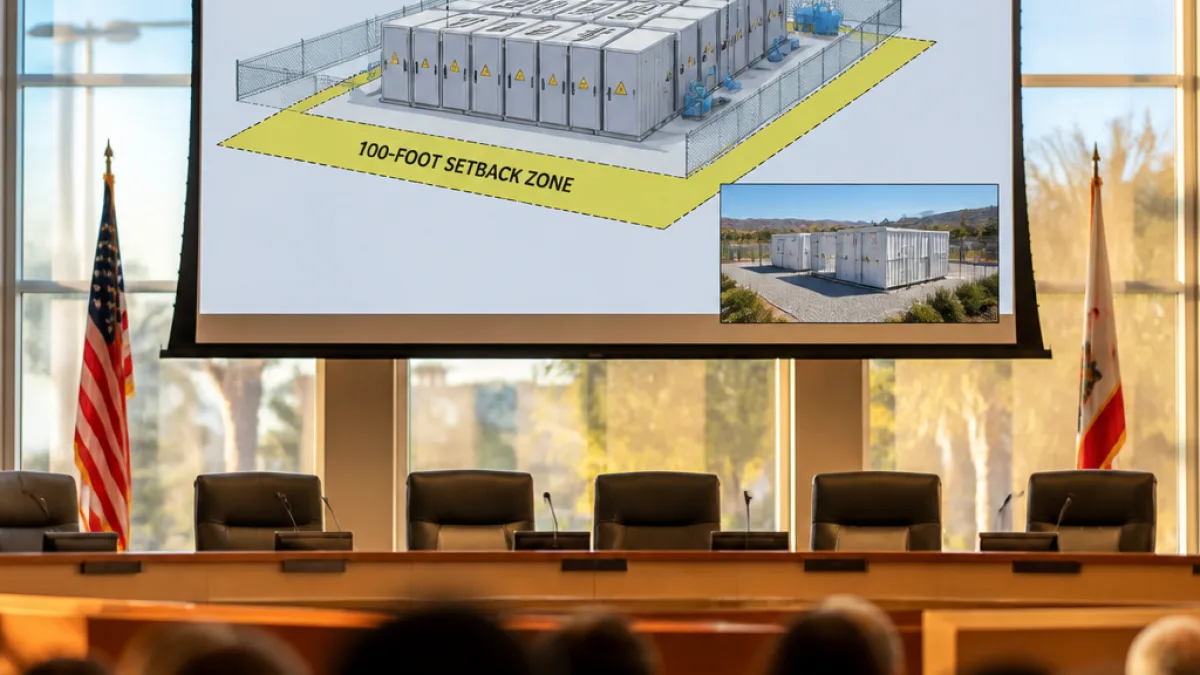
Under the adopted guidelines, any BESS proposed inside city limits must include a fire suppression system, an explosion control system and a minimum 100-foot setback from nearby occupied structures. City officials made clear that those are baseline requirements: the setback can increase when a facility is located near sensitive sites such as schools or hospitals, or when technical analyses show a broader risk area.
Acting Fire Chief Tyler Batson said Escondido worked closely with San Diego County as the county assembled detailed requirements with subject matter experts. The city’s new rules largely mirror the county’s approach and were adopted ahead of the council’s moratorium expiration in October.
“They were doing a lot of due diligence with subject matter experts to develop a very detailed guideline moving forward on the requirements,”
Batson also emphasized the role of plume analysis reports — specialized studies that map potential smoke and contaminant dispersion should a catastrophic BESS fire occur. Those plume models can extend required setbacks if analysis shows hazardous smoke or particulate fallout would reach nearby neighborhoods or facilities.
- Baseline equipment: fire suppression and explosion control systems.
- Baseline separation: 100-foot setback from occupied properties.
- Expanded protections: larger setbacks and additional mitigation if plume analysis or proximity to sensitive uses warrants it.
Former firefighter Kenneth Rice, who reviewed the council action, praised the move as sensible infrastructure planning and not an afterthought. He told NEXO RADAR the protections should be integrated in the design and construction stages, rather than retrofitted.
“It just needs to be built into the infrastructure,”
The safety debate traces back to a Sept. 5, 2024, fire at a San Diego Gas & Electric battery storage facility that forced evacuations of nearby schools and businesses. That incident — together with an earlier, prolonged fire in Otay Mesa in May 2024 that took weeks to fully extinguish — prompted the city to impose a moratorium while regulations and best practices were reviewed.
What the rules mean for Escondido development
With the moratorium lifted, developers and utilities seeking to site BESS installations in Escondido will move forward under a clearer regulatory framework. The new guidelines will shape project design, permitting timelines and siting decisions, particularly in denser neighborhoods and near critical facilities.
City staff noted that while some projects may comply with the baseline measures, others will require additional engineering, mitigation and public review if plume analysis indicates risk corridors extending beyond the 100-foot minimum. Those technical studies can affect land valuations and the types of parcels considered suitable for storage.
Public safety advocates say the rules provide reassurance but call for careful enforcement. The requirement for explosion control systems and plume modeling will demand both technical capacity from applicants and vigilance from the city to ensure submittals meet standards.
| Requirement | Purpose |
|---|---|
| Fire suppression system | Rapidly control and extinguish thermal events. |
| Explosion control system | Mitigate blast risks and direct pressure away from populated areas. |
| 100-foot setback (minimum) | Separate storage arrays from occupied structures; expandable via plume analysis. |
Council action reflects a regional approach to a complex technology that promises grid benefits but carries unique hazards. For Escondido residents, the decision redraws the boundaries where BESS projects can be sited and sets the technical bar proponents must meet to secure approvals.
As projects return to the permit pipeline, city staff and the fire department will play central roles reviewing plume analyses and enforcing construction-stage safety measures. Neighbors and community groups will likely continue to monitor proposals, especially where sites abut schools, care facilities or dense housing.
The council’s vote does not ban storage technologies; it frames how the city will allow them while prioritizing public safety and aligning its standards with the county’s technical guidance.