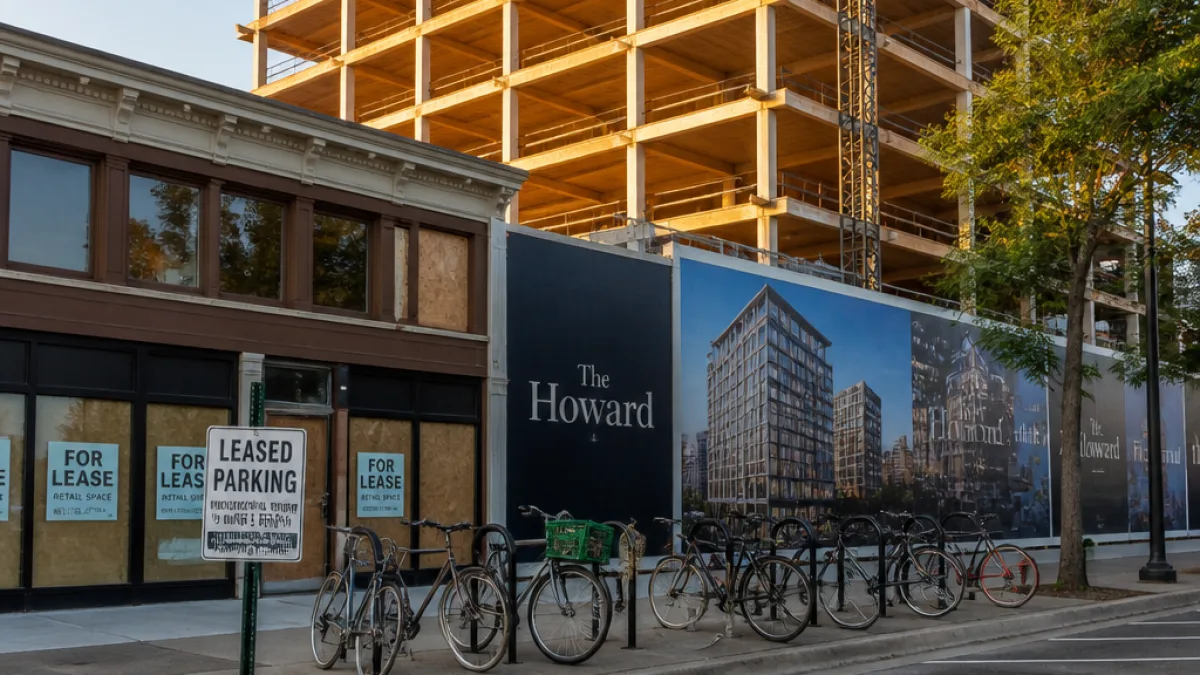
The East Lansing City Council has approved a 12‑story apartment tower to replace the long‑standing Student Book Store and adjacent businesses, clearing the way for a large, mass‑timber project that will reshape a central block of downtown. The development, named "The Howard" in honor of co‑founder Howard Ballein, is planned to contain nearly 300 residential units and a mix of transportation and retail features that officials say are designed for a dense, college‑centered neighborhood.
Scope, materials and capacity
Planned as a mass timber structure, The Howard follows a 2024 East Lansing push to incentivize timber construction for its environmental and aesthetic qualities. The building will span 12 stories and include:
- 296 apartments (a mix of one‑, two‑ and three‑bedroom units)
- Capacity to house 748 people
- Estimated pricing at about $1,200 to $2,200 per bed
The ground floor will reserve space for two commercial tenants described in the site plan as restaurants, although developers had not finalized lease agreements for those spaces at the time the council voted.
Parking, bikes and neighborhood logistics
The plan addresses non‑automotive transportation with 375 bike parking spaces, underscoring East Lansing’s push for bike‑friendly design near the Michigan State University campus. Vehicle parking will be handled through a lease arrangement: the developer will lease 224 parking spaces from the city’s municipal parking system rather than build a large on‑site garage.
| Feature | Planned Quantity |
|---|---|
| Total units | 296 |
| Planned residents | 748 |
| Bike parking | 375 |
| Leased city parking spaces | 224 |
| Estimated rent per bed | $1,200–$2,200 |
History, naming and reaction
The development will replace the Student Book Store and surrounding businesses on the block. The building’s chosen name honors Howard Ballein, co‑founder of the bookstore, and the Ballein family has operated the store since 1960. Greg Ballein, the current owner, framed the naming as a personal legacy for his children and grandchildren.
"Calling it ‘The Howard’ … that’s something our grandkids can look at in the future and say, ‘wow my grandpa built that—that’s cool,'" Greg Ballein said. "You want them to be proud of you, just like I was proud of my father … that’s the whole point."
Timeline, approvals and outstanding questions
The council approved The Howard at its July 21 meeting after deferring a vote in June. The project initially had a schedule with a ground‑breaking set for Aug. 3 and a completion date in July 2028, but that timeline was pushed back when the council deferred action earlier in the summer. The developers have not announced updated firm construction or demolition dates since approval.
Several practical questions remain for Lansing area residents and city officials as the project proceeds. The exact food or retail tenants for the two ground‑floor spaces are not yet secured, and the commitment to lease 224 municipal parking spaces will require coordination with the city’s parking management and could affect supply for other downtown users. The concentration of nearly 750 residents on a single block also has implications for neighborhood services, traffic flow, transit demand and the character of the downtown corridor adjacent to Michigan State University.
The Howard represents a notable example of East Lansing’s current development priorities: higher‑density housing near campus, a move toward mass‑timber construction and reliance on shared municipal infrastructure rather than private parking stock. For Lansing residents watching growth patterns in the region, the project will be a test case for how the city and university neighborhoods accommodate new housing at scale while preserving local retail and managing transportation impacts.
As the developers finalize demolition, construction schedules and tenant agreements, city officials and neighbors will have multiple checkpoints to evaluate how the project aligns with long‑standing downtown plans and community expectations.