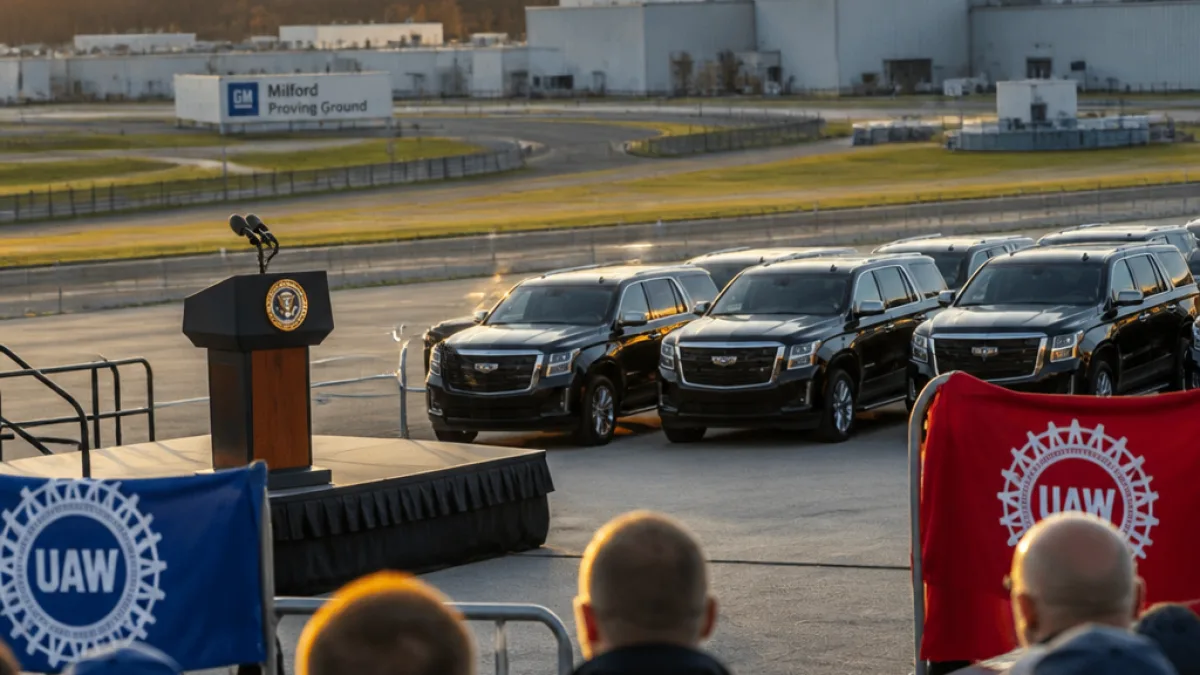
MILFORD, Mich. — President Donald Trump told a gathering of autoworkers at a General Motors testing facility outside Detroit that he has done more to improve their lives than their parents, a blunt line in a campaign-style speech that mixed trade boasts, attack lines at union leadership and a defense of his administration’s tariffs.
Speaking less than 100 days before the midterm elections, Trump used the 65-minute appearance to press his argument that his policies have revived American auto manufacturing and to try to peel union members away from the Democrats. He singled out United Auto Workers President Shawn Fain for criticism after the union endorsed Democrats in the 2024 presidential race, and he credited tariffs on foreign automobiles with helping the domestic industry.
"I've done more for you than your parents, OK? ... I'm not going to knock your parents, but I have been better to you than your parents. That I can tell you, and they would agree with me."
The president also cited what he called a surge in truck and SUV production at GM, saying the company’s output is up by 20 percent in 2026. While production figures can be volatile and vary by model and plant, national labor statistics paint a more mixed picture: preliminary seasonally adjusted June numbers from the U.S. Bureau of Labor Statistics show employment in autos and auto parts is down about 4 percent nationally from December 2024, the month before Trump returned to the White House. In Michigan, total manufacturing jobs fell 2.5 percent during the same period.
Tariffs and trade: selling benefits amid local concerns
Trade policy was central to Trump’s remarks. He reiterated that tariffs he has imposed on foreign automobiles have strengthened U.S. manufacturing, a cornerstone of his pitch to blue-collar voters. The claim arrives amid debate over whether tariffs protect domestic jobs or raise costs for consumers and manufacturers who rely on integrated global supply chains.
Michigan’s economy is deeply tied to cross-border and international supply lines. Business and political observers have warned that tariffs can produce uneven results — bolstering some production while raising input costs or inviting retaliatory measures that strain other industries.
Union politics and voter outreach
Trump’s speech also took aim at UAW leadership. He mocked suggestions that Shawn Fain had been fired — though Fain remains the union’s president — and argued that autoworkers themselves back Trump’s agenda regardless of union endorsements.
The explicit outreach to autoworkers is a continuation of a long-running effort by Trump to cultivate support among working-class, union households who in 2024 helped flip Michigan back into his column after his defeat four years earlier. The administration has repeatedly highlighted anecdotal and localized manufacturing gains in battleground states as evidence of broader industrial revival.
- Speech length: 65 minutes
- Production claim: GM truck and SUV production up 20% in 2026 (per Trump)
- Labor market context: Autos and parts employment down ~4% nationally since December 2024; Michigan manufacturing jobs down 2.5%
| Measure | Reported change |
|---|---|
| GM truck/SUV production | +20% (2026, per Trump) |
| Autos & auto parts employment (U.S.) | -4% (Dec 2024 to June preliminary) |
| Total Michigan manufacturing jobs | -2.5% (same period) |
Trump also announced a recent purchase of 250 Cadillac Escalades for the presidential motorcade during the event, a detail he used to underscore his emphasis on domestic manufacturing and showmanship.
Local political strategists said the visit is meant to reinforce the president’s blue-collar appeal as the midterms near. Democrats, meanwhile, can point to the employment statistics as ammunition to question whether manufacturing gains are broad-based and who ultimately benefits from tariff-driven policies.
For Michigan voters, the speech mixes tangible claims — production boosts and vehicle purchases — with political narratives about loyalty and economic stewardship. Whether those claims resonate will depend in part on voters’ personal experiences at assembly lines, dealerships and their household ledgers.
As the campaign season tightens, Michigan remains a state where economic messages, union endorsements and nuanced trade impacts intersect. The president’s visit underlines how closely national political strategy continues to follow the state’s auto industry lifeblood.
Marcellus Boyd, Michigan correspondent at NEXO RADAR, contributed reporting from Milford.