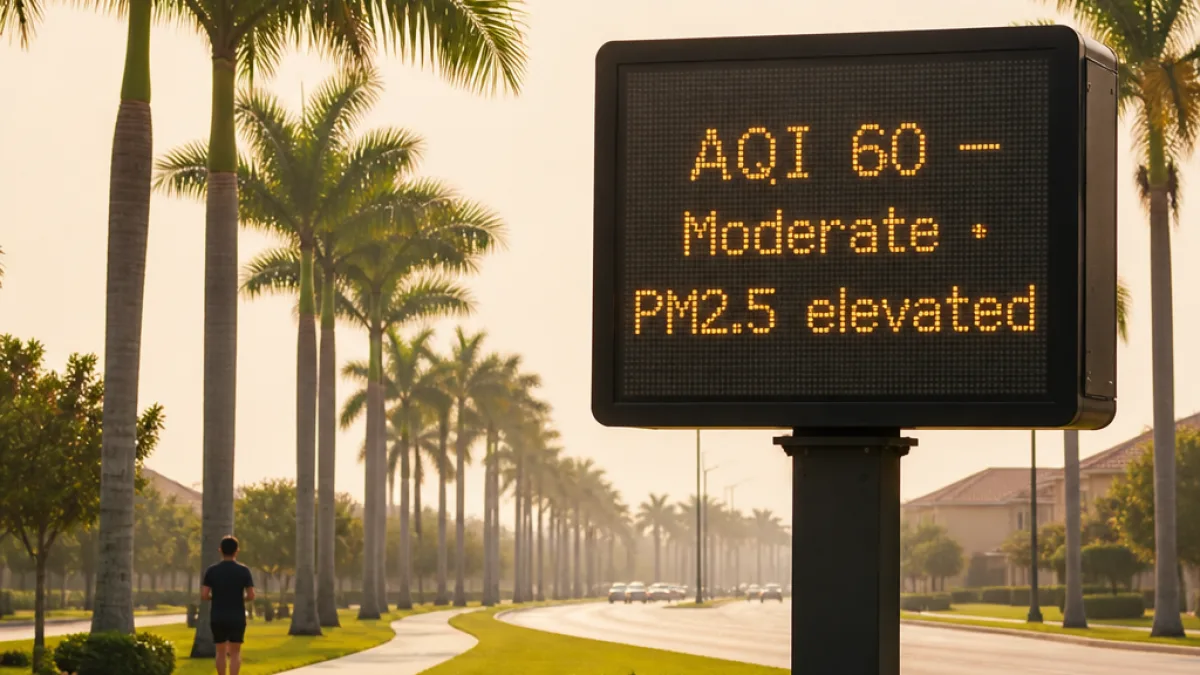
Miramar, FL — Hourly air-quality readings released by IQAir show Miramar’s air remaining in the moderate range today, while concentrations of fine particulate matter (PM2.5) register at roughly twice the World Health Organization’s annual guideline. The forecast projects AQI values edging upward through the afternoon before easing overnight, prompting health recommendations for sensitive groups.
What the numbers mean for people here
The IQAir hourly feed lists AQI values beginning in the low 50s in the early morning and rising into the upper 50s and low 60s during the afternoon. Those readings correspond to a moderate air-quality classification, which means most people are unlikely to be affected, but some individuals — especially those with respiratory or heart conditions, children and older adults — could experience symptoms if they spend extended time outdoors.
- Current AQI: about 52–56 in the early hours
- Afternoon peak: forecast to reach upper 50s to low 60s
- Primary concern: PM2.5 fine particles measured at about twice the WHO annual guideline
Temperatures and wind speeds accompany the AQI numbers in the forecast: light to moderate breezes are expected through the day, with humidity staying high. Those conditions can influence how pollutants disperse across Broward County neighborhoods.
Hourly trend and timing
The detailed hourly schedule shows stable readings in the early morning, with gradual increases by mid- to late-afternoon. By evening and into the overnight hours the index dips again, according to the IQAir timeline. Residents planning outdoor exercise or activities should consider the timing: afternoon hours are the most likely window for higher particulate concentrations.
| Time (approx.) | Forecast AQI | Temp / Wind |
|---|---|---|
| Early morning | 52–56 | ~15–17°C, light breeze |
| Afternoon | 57–61 | ~19–21°C, 7–12 km/h |
| Night | 54–58 | ~16–18°C, variable |
"PM2.5 concentration is currently 2 times the World Health Organization annual PM2.5 guideline value."
That assessment — included in the monitoring snapshot — is the clearest signal for residents who are sensitive to air pollution. Exposure to elevated PM2.5 over time is linked to increased respiratory and cardiovascular risks, so local health authorities typically advise limiting strenuous outdoor activity when concentrations climb.
Local context and what to watch for
Miramar sits amid dense residential areas, commercial corridors and major roadways that can contribute to local particulate loading, especially during calm conditions. While the current AQI levels are not at unhealthy thresholds, the sustained presence of fine particles at multiples of WHO guidelines for annual exposure is noteworthy. The difference between short-term moderate AQI readings and longer-term exposure metrics matters: a day in the 50s won’t usually trigger action for healthy residents, but repeated days add up.
Residents with asthma, COPD or heart disease should keep quick-relief medications nearby, avoid heavy outdoor exertion during the afternoon peak and consider staying in air-conditioned spaces when possible. Parents of young children and those caring for older adults should also be mindful of outdoor plans for the coming days.
City and county officials monitor regional air conditions and issue advisories when thresholds are exceeded. For now, IQAir’s forecast suggests a pattern of modest elevation rather than an acute event, but the situation can change with shifts in wind, wildfire smoke transport or local emissions.
Miramar residents can track real-time conditions through local public-health channels and independent monitoring services; staying informed helps families choose the best times for outdoor recreation and reduces unnecessary exposures on days when pollutants rise.