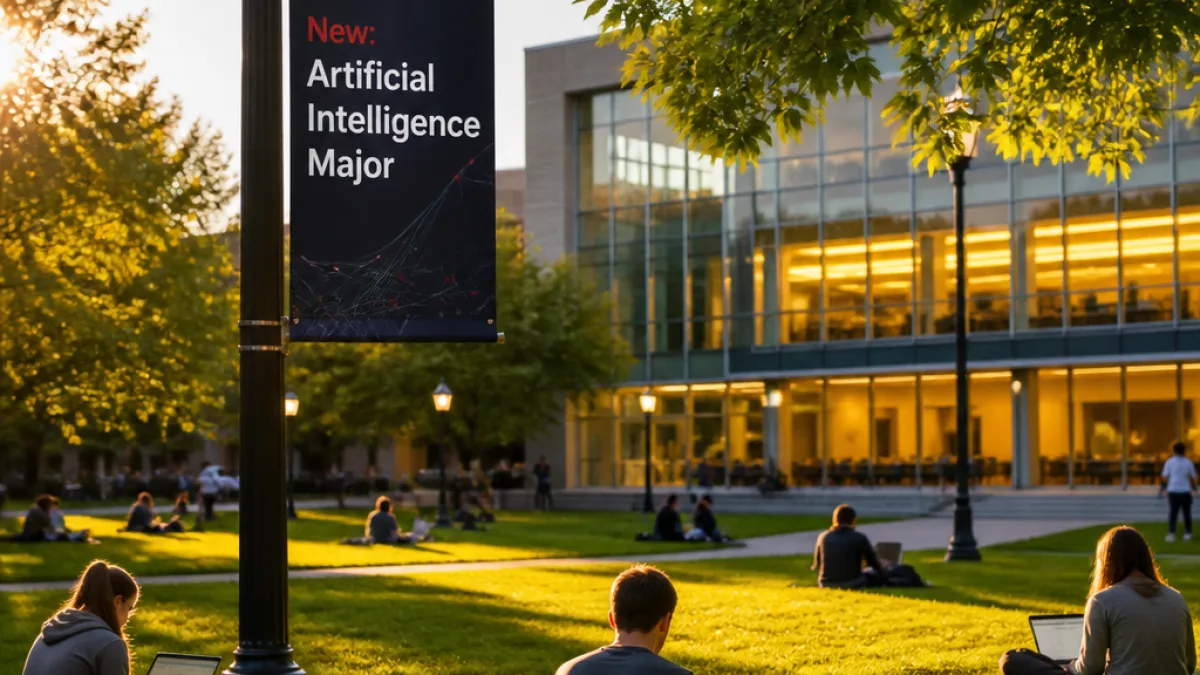
Maryland colleges are expanding degree offerings in artificial intelligence as more students rely on generative tools in their coursework, aligning local moves with a national surge in AI-focused majors.
New programs arrive amid rising student use
The University of Maryland, College Park, Morgan State University and other institutions in the state announced new majors and programs this summer that allow students to graduate with a degree explicitly labeled "artificial intelligence." These launches come as universities across the country report a sharp increase in AI-related degree programs.
Research by Carla Brodley, dean of inclusive computing at Northeastern University, found a 36% increase in AI majors at colleges nationwide between December and June. That growth coincides with findings from a 2026 Lumina Foundation–Gallup study showing that 57% of college students use AI in their coursework at least weekly and that one in five students use it daily.
What Maryland is offering
At Maryland’s flagship campus, leaders unveiled two bachelor’s degree tracks developed in partnership with the Artificial Intelligence Interdisciplinary Institute at Maryland. One of the new options is a major in human-centered artificial intelligence, designed to teach students to evaluate ethical implications and identify biases in systems.
- Core course offerings listed for the human-centered AI major include: Gender, Race and Computing; Privacy, Security and Ethics for Big Data; and Designing Fair Systems.
- Students can specialize in themes such as the arts, ethics, or law, policy and governance.
- The degrees are advertised for students interested in careers across sectors, including arts, business, education, government and law.
Voices urging caution on hyperfocused majors
Not everyone in academia embraces standalone AI degrees. Lisa Meeden, a computer science professor at Swarthmore College who has spent three decades studying robot learning, described the trend as a potential overcorrection.
“We really need students to be solid computer scientists that understand the theory and basic foundation of what AI is built on top of,” she said. “Just focusing on the latest, greatest tool and how to interact with it doesn’t give you the foundation of truly understanding it.”
Meeden characterized AI majors as “the trendy thing” and suggested students might be better served by a core computer science education supplemented with AI coursework. Those concerns reflect a broader debate about balancing technical foundations with rapidly evolving toolsets.
Data at a glance
| Measure | Value |
|---|---|
| Increase in AI majors nationwide (Dec–Jun) | 36% |
| Students using AI weekly | 57% |
| Students using AI daily | 20% (one in five) |
What this means for Maryland students
For students in Maryland, the emergence of AI majors offers new pathways but also raises practical questions about preparation and long-term value. Programs that emphasize ethics, fairness and interdisciplinary themes may broaden options beyond narrow technical roles, appealing to students who want to bring AI literacy into public-sector work, education, law or the arts.
At the same time, faculty who study the field warn that a narrowly focused degree risks leaving graduates with shallow tool-oriented training rather than deep theoretical grounding. That could matter for graduates who later need to adapt as architectures and frameworks change.
For parents and prospective students evaluating the new programs, comparing course lists, departmental foundations and opportunities for internships or cross-disciplinary study will be important. Maryland’s new offerings appear to explicitly include ethics and governance tracks — features advocates say are critical as AI systems increasingly affect public life.
As these programs enroll their first cohorts, observers will be watching whether graduates enter jobs aligned with their training and whether curricula evolve to balance foundational computer science with applied AI skills.
These developments in Maryland reflect a national recalibration in higher education as institutions attempt to respond to rapid changes in technology and student behavior. For students whose work already includes daily reliance on AI, the question is whether a specialized degree will deepen understanding or merely formalize a trend that has already taken hold on campus.