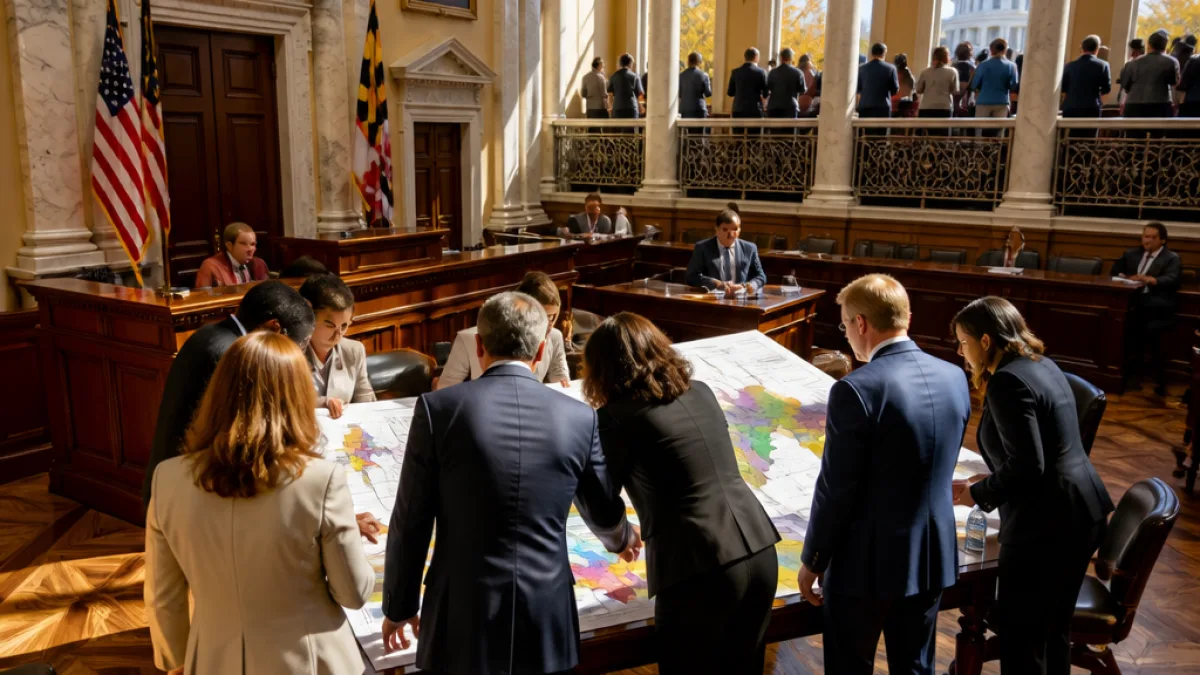
ANNAPOLIS — Lawmakers in the General Assembly spent two days this week debating a constitutional amendment that would clarify Maryland’s power to draw congressional boundaries — a debate that repeatedly circled back to Rep. Andy Harris and the political stakes for the Eastern Shore.
Democrats, who passed the amendment during the special session, say the change responds to what they describe as a national problem: a mid-decade gerrymander pushed by national Republicans. If voters approve the amendment, Democrats would likely redraw congressional lines for the 2028 cycle, a move that could alter the trajectory of Harris’ political future.
The amendment provoked sharp rhetoric on the House floor and in hallways, where some Republican delegates framed the vote as a personal attack on Harris, celebrating his connection to Eastern Shore voters and describing him as uniquely positioned to represent local interests in Washington.
“This one’s personal for a lot of us,”
Del. Lauren Arikan said the chamber should reject the amendment, invoking Harris by name and stressing constituent representation. Her comments illustrated how redistricting — generally a dry, technical subject — has become intensely personal for some legislators.
Politics, maps and a possible 10th term
Legislative debate included references to national politics and federal court fights, but local lawmakers kept returning to a simpler, immediate point: the amendment could affect who gets to represent the 1st Congressional District in future terms. Democrats acknowledged that if Harris wins this November against Democrat Dan Schwartz and seeks reelection, a yet-undrawn map might prevent him from serving a 10th term.
Republicans argued the change would weaponize state power to unseat a sitting member and suppress the voice of Eastern Shore voters. Del. Christopher Adams of Wicomico County urged colleagues to reject the amendment, saying Harris could speak to watermen, farmers and small-business owners and would defend Ocean City’s interests.
Gov. Wes Moore and legislative Democrats framed the amendment as a necessary step to counter what they called strategic, mid-decade mapmaking elsewhere. They presented it as a measure to keep Maryland’s congressional maps under state control and responsive to a majority in the State House.
What happens next
The amendment now goes to voters for approval. If affirmed, the State House majority would have clearer authority to redraw congressional boundaries, likely ahead of the 2028 election cycle. The process and timing of any map redraw will carry political consequence for incumbents and challengers alike.
| Action | Timing / Note |
|---|---|
| Passage of constitutional amendment in General Assembly | During special session (this week) |
| Voter approval required | Next step before amendment takes effect |
| Potential redrawing of congressional maps | Likely for 2028 if amendment is approved |
- Immediate political impact: The amendment raises the prospect that the 1st District’s borders could change before the next full redistricting cycle.
- Local concerns: Delegates from the Eastern Shore argued the change could dilute their constituents’ long-standing representation in Congress.
- Broader implications: Supporters say the move is defensive against national mid-decade mapmaking; opponents call it a partisan power grab.
For voters on the Eastern Shore and elsewhere in Maryland, the debate is more than abstract discussion of lines on a map. It reaches into daily concerns: who will advocate for agricultural aid, fisheries, tourism and other local priorities in Washington. That context helps explain why delegates invoked the names and careers of individual members rather than confining remarks to constitutional mechanics.
As the issue moves from Annapolis to the ballot box, residents will have the chance to weigh in directly. The question before voters will determine not only how maps are drawn but also how accountable representatives are to the communities they claim to serve. For people who feel their voices are already on the margins, the stakes are immediate: redistricting can change which communities have influence and which struggle to be heard in Washington.
The amendment’s passage in the legislature begins a new chapter in a recurring story: the tug-of-war between state power and federal representation, between partisan strategy and community voice. Whatever the outcome at the ballot, the debate this week underscored how closely maps and politics are intertwined — and how often those discussions ultimately land on the people most affected.
Karim Fahmy is the Maryland correspondent at NEXO RADAR.