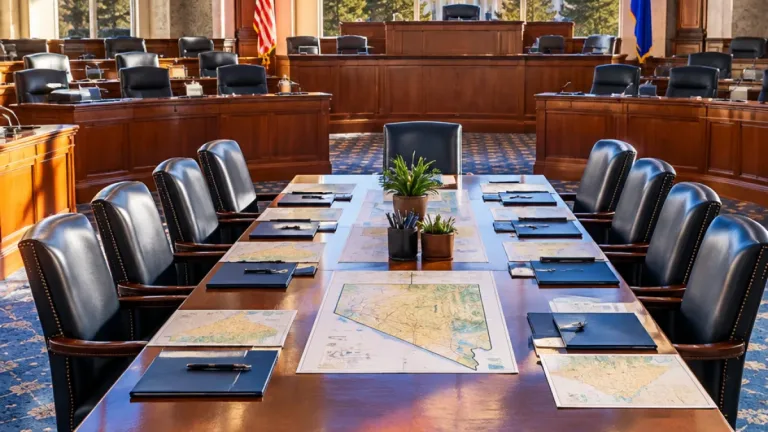

ANNAPOLIS — The Maryland House of Delegates advanced a constitutional amendment Tuesday that would clear the way for a new congressional map in time for the 2026 election cycle, approving the measure 96-38 during a special legislative session.
What lawmakers did
The amendment would permit the General Assembly to redraw U.S. House district lines outside the once-a-decade schedule tied to the federal census. Proponents framed the move as a response to Republican-led mid-decade map changes in several other states; critics called it an explicit attempt to consolidate Democratic advantage in Maryland.
| Item | Figure |
|---|---|
| House vote | 96-38 |
| Maryland U.S. House seats currently held by Democrats | 7 of 8 |
Voices from the debate
Opponents in the chamber warned that the amendment would be a partisan maneuver. Republican lawmakers argued constituents did not support mid-decade redistricting and said the change would be a “power grab.” One GOP lawmaker expressed the view bluntly on the House floor.
“Just because we can go ultra-partisan doesn't mean we should go ultra-partisan.”
— Delegate Kevin Hornberger (Republican)
Senate Republicans echoed the criticism. State Senate Minority Leader Steve Hershey said the amendment was an effort to “cheat” and eliminate the lone Republican member of Maryland’s congressional delegation, referring to the 1st District seat. Democrats rebutted by pointing to recent Republican-led redistricting in other states.
“It was Donald Trump who started this whole Pandora’s Box of a slippery slope down to the bottom.”
— Sen. Cheryl Kagan (Democrat)
Local impacts and concerns
Beyond party strategy, some lawmakers expressed concern about how district reshuffling could affect communities, particularly rural areas. One Democratic lawmaker cautioned that merging rural counties with suburban jurisdictions could dilute rural voices and jeopardize federal resources tailored to local needs.
For residents of Eastern Shore counties and other rural regions, the debate is not only about who wins elections. It touches services, federal funding formulas and the degree to which elected officials prioritize local infrastructure, health care access and economic development. Those everyday consequences are often left out of high-level political math, yet they are among the clearest ways a redrawn map could change life for ordinary residents.
Broader context
The move in Annapolis follows a national pattern this year of mid-decade map changes. According to lawmakers’ remarks on the floor, several GOP-controlled states have redrawn districts to favor Republicans in the 2026 midterm cycle. The AP-account cited states including Alabama, Florida, Louisiana, Missouri, North Carolina, Ohio, Tennessee and Texas as having redrawn maps that could help Republicans pick up seats — with California and Utah producing maps favorable to Democrats.
Maryland’s action is the latest example of how the tug-of-war over congressional maps has intensified outside the traditional post-census timetable. Supporters here say the state must be responsive and defend its political representation; opponents see partisan tit-for-tat that further erodes public trust.
Next steps
The amendment must secure three-fifths approval in both chambers of the General Assembly to be placed on the November ballot. The House vote clears one hurdle; the state Senate was expected to vote later the same day. If the Senate approves, Maryland voters will decide the change in the Nov. 3 general election.
- What voters will see: If the Senate approves, the proposal would appear as a constitutional amendment on the November ballot.
- Why it matters: Passage would allow mid-decade redistricting potentially to reshape Maryland’s congressional delegation.
- Who is watching: Both national parties and local advocacy groups, with particular attention on rural communities that fear losing distinct representation.
Reporting on the people behind the numbers
Lawmakers’ vote tallies and political strategy are important, but so are the residents whose daily lives hinge on where district lines fall. Hospital systems, school districts and small-business owners feel shifts in who advocates for federal projects and grants. In the weeks ahead, as the Senate completes its work and — if approved — Marylanders prepare to vote, the debate is likely to sharpen around who in the state will gain voice and who may lose it when new lines are drawn.
The action in Annapolis adds Maryland to a national story about how states manage congressional maps outside the once-a-decade rhythm. For many Marylanders, the question at the ballot box will be less about partisan scoreboard and more about whether their community’s needs will be heard in Washington.