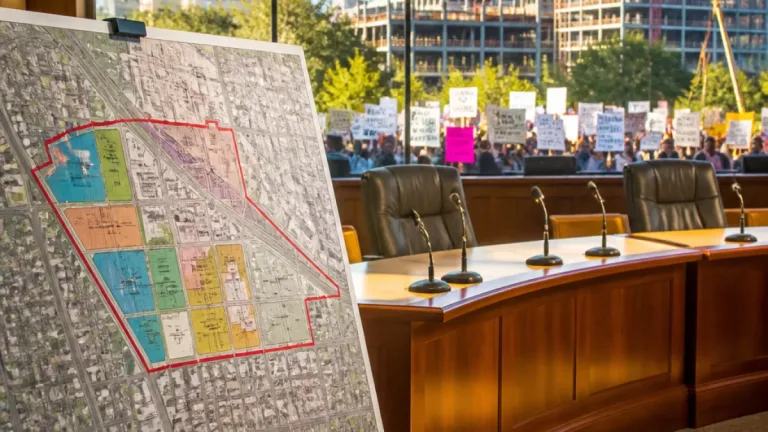
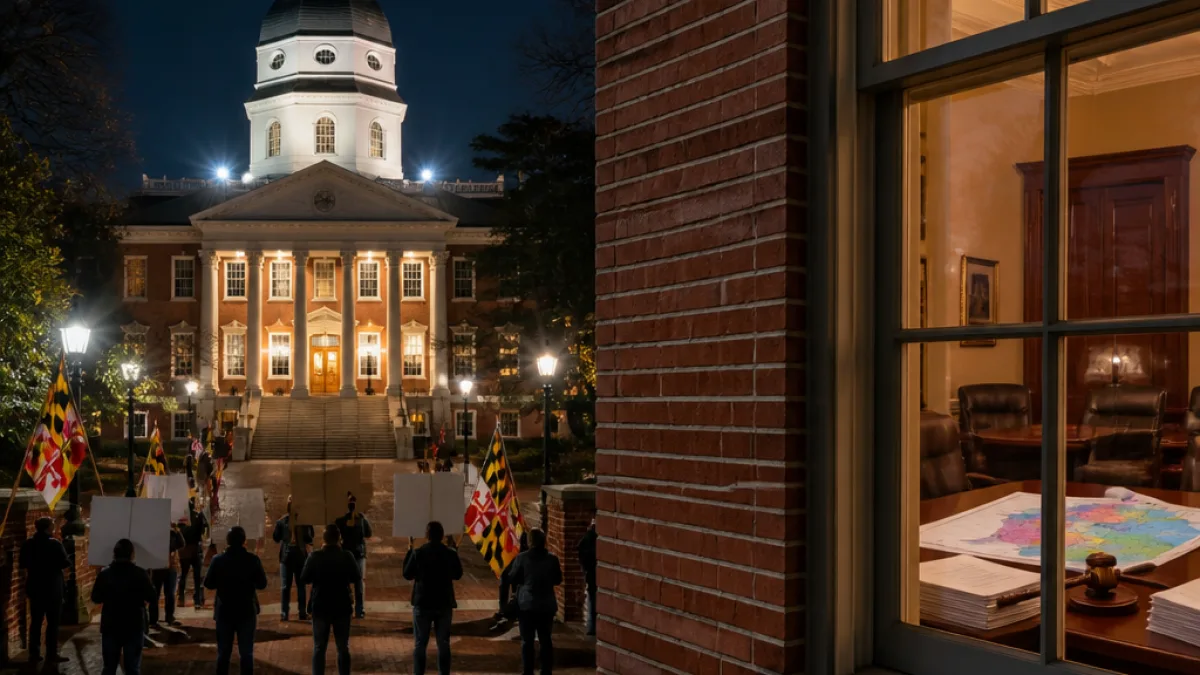
ANNAPOLIS — Maryland lawmakers began a special legislative session Monday to consider a proposed constitutional amendment that would alter how the state draws its congressional districts and potentially allow the Democratic majority broader latitude to reshape U.S. House boundaries ahead of the 2028 elections.
The move comes in a state where Democrats currently hold seven of eight congressional seats. Supporters say the amendment is a preemptive step to protect minority voters and preserve Democratic representation after a change in federal jurisprudence; critics, including state Republicans, call it an overt partisan power grab.
Why lawmakers are moving now
Democratic leaders say their position shifted after a recent U.S. Supreme Court decision that weakened portions of the Voting Rights Act, creating new legal openings for Republicans in other states to redraw maps in ways that could reduce representation for communities of color and Democratic voters. Maryland Senate President Bill Ferguson cited those developments as a motivating factor.
“It felt like the unwinding of any type of democratic norms in the blink of an eye,”
Ferguson has previously blocked more aggressive map changes out of concern they would not withstand judicial review. Lawmakers are now pursuing a different path: amending the state constitution to clarify the rules under which lawmakers may draw congressional boundaries. Because the amendment would change the state charter, it must first pass the General Assembly and then be approved by Maryland voters before new district lines could be proposed or enacted.
Political stakes and local impact
The immediate target of the proposal is the state's only Republican U.S. representative, Rep. Andy Harris, whose 1st Congressional District covers Maryland’s mostly rural Eastern Shore. In 2021, Democrats attempted to redraw maps in a way that made the 1st District more competitive by including communities across the Chesapeake Bay; a judge struck down those maps in 2022, calling them the "product of extreme partisan gerrymandering." That ruling remains a cautionary touchstone for lawmakers crafting any new approach.
Supporters of the amendment argue it would give the General Assembly the clarity and legal footing to pursue maps that preserve minority voting strength and fair representation. Opponents say it would enshrine partisan advantages into the state constitution, reducing judicial oversight and public trust.
- What lawmakers will do now: debate the proposed constitutional amendment during the special session.
- Next steps if passed by the legislature: the amendment would be placed on a statewide ballot for voter approval.
- Potential timeline: any new congressional maps could not be pursued until the amendment is approved by voters, with officials citing 2028 as the target for map changes to take effect.
Legal context and the careful calculations
Maryland Democrats have been cautious since the 2022 court ruling against the 2021 map changes. That decision, along with the Supreme Court’s recent curtailing of the Voting Rights Act’s scope, has prompted Democratic leaders to seek a route that reduces the risk of future maps being overturned. By placing the standards for congressional mapmaking into the state constitution, proponents hope to create a clearer legal foundation that better withstands court scrutiny.
Republicans counter that the tactic amounts to circumventing checks on partisan line-drawing. In a state where Democrats already control most congressional seats, the change would likely alter the political calculus for voters and candidates across Maryland’s regions, from Baltimore and Montgomery County to the Eastern Shore.
| Current U.S. House delegation (Maryland) | Seats |
|---|---|
| Democrats | 7 |
| Republicans | 1 |
Voices often left out
Behind the legal arguments are voters and communities whose daily lives hinge on how districts are drawn: neighborhood groups, church congregations, small-business owners and residents in both rural and urban parts of the state. For many, the debate is less about abstract doctrine and more about whether their voices will be grouped with similar communities or split across lines that dilute political influence.
For residents on the Eastern Shore, changes to the 1st District could mean a shift in representation that affects federal attention to local priorities such as agriculture, fisheries and infrastructure. In suburban and urban districts, adjustments to lines can change which communities share a representative and which priorities a candidate must address.
What to watch
Key items for Marylanders to follow in the coming weeks include the details of the amendment language, the vote count in both legislative chambers, and whether the proposal will secure enough support to reach the ballot. Any amendment that reaches voters could reshape Maryland’s political landscape for the next decade, making the special session a consequential moment for how the state approaches federal representation.
As lawmakers weigh technical language and political trade-offs, the debate underscores a larger national struggle over who draws the maps and by what rules — a contest with tangible consequences for families and neighborhoods often missing from the headlines.