
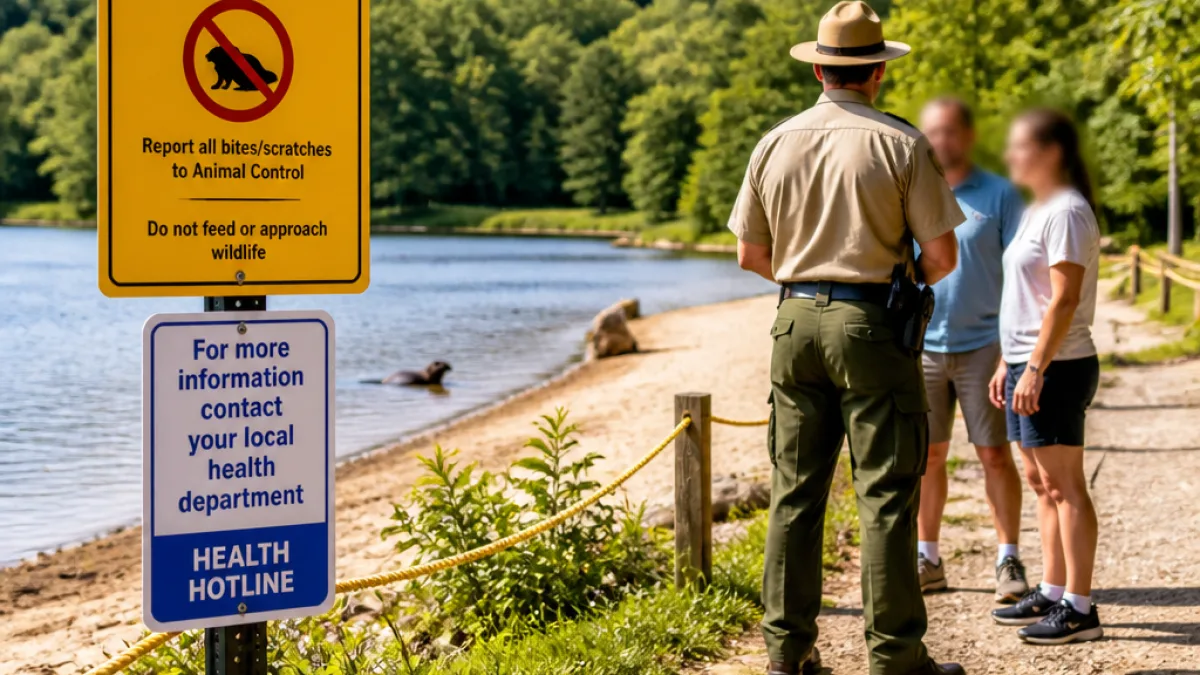
FREDERICK COUNTY, Md. — Maryland wildlife and health officials have closed additional shoreline and water-access areas at Cunningham Falls State Park after state testing confirmed a second beaver with rabies in less than two weeks.
Two human bites, two positive tests
The latest incident occurred Wednesday morning near the South Beach Day Use Area at Hunting Creek Lake, when a 19-year-old fisherman reported being bitten on the ankle by a beaver, officials said. The man drove himself to Meritus Medical Center in Hagerstown for treatment. Natural Resources Police captured and euthanized the animal; laboratory tests later returned positive for rabies.
This follows a July 27 confirmation that a beaver involved in an earlier incident — in which a 13-year-old swimmer was bitten in the same area — also tested positive for rabies. Those two confirmed cases have prompted the Department of Natural Resources to expand closures and increase monitoring of the lake.
What’s closed and what remains open
Officials said activities that require direct water access are not allowed while investigators assess whether there is a broader outbreak among the local beaver population. Both short-term public safety measures and ongoing park uses were described by authorities.
| Park area | Status |
|---|---|
| Houck Day Use Area | Closed |
| Boat ramp | Closed |
| Big Hunting Creek above the lake | Closed |
| Campground and other park areas | Open |
Increased surveillance and public guidance
The Department of Natural Resources said crews will step up daytime surveillance and begin monitored patrols at night, calling the effort a kind of “Beavercam.” Officials emphasized that beaver attacks are rare — these animals typically avoid people — but the unusual sequence of events has forced a precautionary response.
Officials urged visitors to remain at least 25 yards away from beavers and to report any contact with wildlife to the county health department.
Public-health officials specifically asked anyone who may have had recent contact with a beaver at Cunningham Falls to call the Frederick County Health Department at 301-600-3342 for guidance and possible follow-up.
Why this matters to visitors and neighbors
Rabies is a viral disease that affects the nervous system and can be fatal if not treated promptly after exposure. Most human cases in the United States are prevented by timely medical care and administration of post-exposure prophylaxis. The two bites at Cunningham Falls — one involving a child and one involving a young adult — underscore how quickly encounters with wildlife can turn dangerous.
For families who visit the lake for swimming, fishing or boating, the closures will limit typical summer activities and raise questions about returning safely. Park officials left the campground open but warned that any activity involving water access is temporarily suspended while the investigation continues.
What visitors should do now
- Avoid water access areas around Hunting Creek Lake and observe all posted closures.
- Keep at least 25 yards away from beavers and other wildlife; do not attempt to feed or approach them.
- If bitten or scratched by a wild animal, wash the wound immediately with soap and water and seek medical care right away.
- Anyone with recent contact with a beaver at Cunningham Falls should contact the Frederick County Health Department at 301-600-3342.
Local impact and lingering questions
For nearby residents and frequent park users, the situation is a reminder that human-wildlife interactions can carry real health consequences. The DNR’s stepped-up monitoring aims to identify other affected animals and to reduce risk to people using the park.
Park staff and wildlife officers will be watching for beavers that appear unusually aggressive, disoriented or focused on people’s ankles — behaviors that can signal rabies. Until the DNR completes its investigation, officials said, activities that require entering the water will remain off-limits.
As the public waits for more details, the immediate priorities are clear: prevent further exposures, ensure anyone potentially exposed receives timely medical evaluation, and determine whether the rabies cases represent an isolated cluster or a wider outbreak among local wildlife.
This developing situation affects visitors planning trips to Cunningham Falls and residents who recreate at Hunting Creek Lake. Officials ask the public to heed closures and to report any sightings or encounters that could help the investigation.