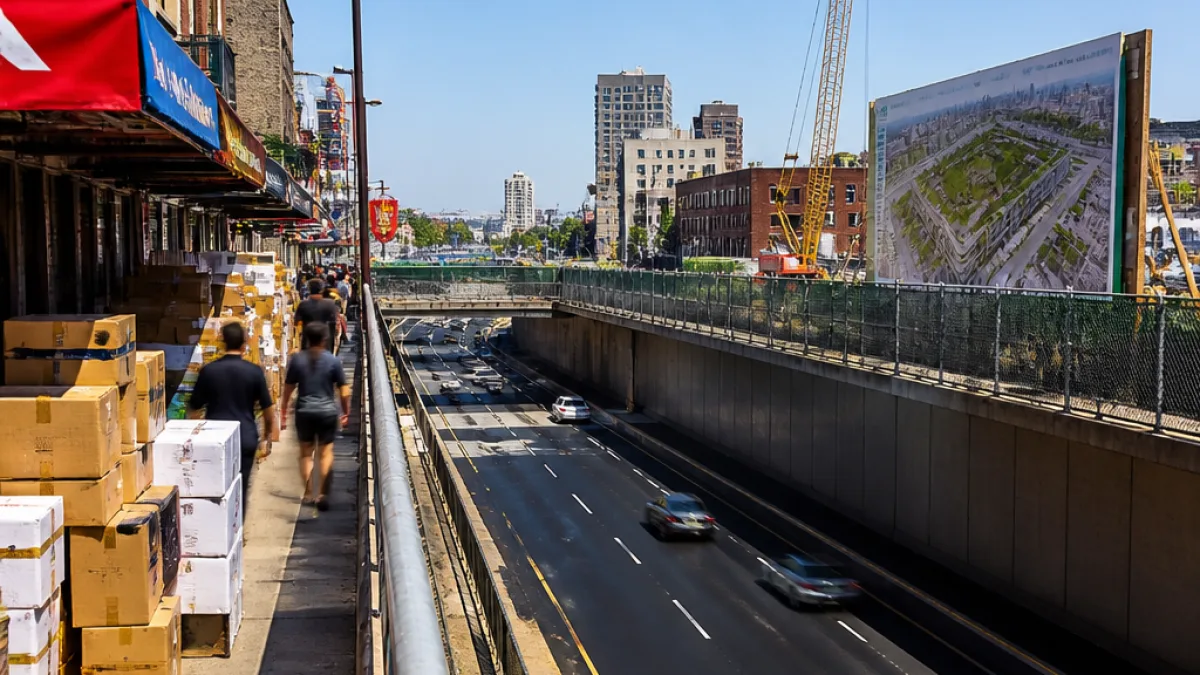
On a hot July afternoon, the narrow sidewalks of Philadelphia’s Chinatown hum with the small urgencies of daily life: delivery boxes stacked at shop doors, elders pausing beneath awnings, children darting between food carts. A two-and-a-half-block gap in that rhythm is obvious only when you stand at the neighborhood’s edge and look across the Vine Street Expressway (I-676), a six-lane trench that cleaves Chinatown from the riverfront and the rest of the city.
From trench to park: a contested promise
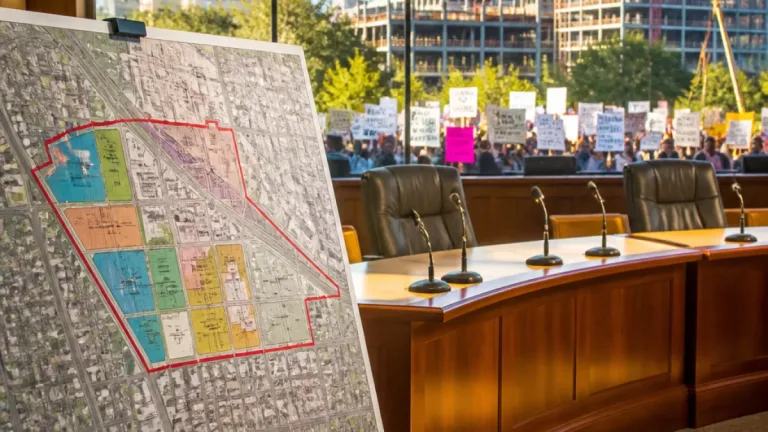
For decades, community leaders have argued that the expressway damaged Chinatown’s future — intensifying heat, generating constant traffic noise and pollution, and starving the neighborhood of public space and pedestrian continuity. In 2021, the Bipartisan Infrastructure Law offered a path to repair that harm and planners saw an opportunity: the Chinatown Stitch, a capped highway with a street-level park meant to reconnect the neighborhood and create usable public land.
Between 2022 and 2024, the Philadelphia Chinatown Development Corporation (PCDC), the city and state secured grant awards together totalling more than $160 million to build the cap. The money represented a rare, large-scale investment in urban reconnection and environmental remediation inside the city.
Federal reversal leaves project scrambling
But those federal commitments did not hold. In 2025, congressional Republicans moved to rescind much of the project funding, leaving only $8 million on the table. The abrupt reduction has forced neighborhood advocates and city officials into an urgent hunt for replacements — turning a concrete plan into a high-stakes political ledger.
The loss of federal funds has local consequences that are immediate and measurable: the project’s design, phasing and timeline all depend on the original scale of support. Without full funding, the cap could be delayed for years, scaled down, or split into phases that deliver piecemeal benefits rather than the comprehensive reconnection residents envisioned.
- Community impact: Reduced air-quality mitigation, prolonged truck and car pollution, continued noise and limited public open space.
- Economic effect: Missed opportunities for local business growth tied to new pedestrian flows and improved streetscapes.
- Planning risk: A smaller or delayed cap could raise construction costs and complicate future grant applications.
Where the money stood — a brief timeline
| Year | Action | Amount |
|---|---|---|
| 2022 | Initial grant award (PCDC, city, state) | Part of >$160M total |
| 2024 | Additional grant award | Part of >$160M total |
| 2025 | Congressional rescindment | Reduced to $8M |
City leaders and planners have picked up some of the slack, tapping regional and municipal sources to keep design work moving. But those funds fall short of replacing the federal commitment and cannot fully substitute for the scale of the original grant awards.
“The Trump administration may have ripped away funding for the Chinatown Stitch, but this fight isn’t over yet,”
The line above captures the tenor of local advocacy: a mixture of frustration at national politics and determination to salvage a transformative neighborhood project. Advocates are now turning their sights to the Delaware Valley Regional Planning Commission, the city’s budget offices and members of Congress to try to restore or replace the lost federal support.
Local stakes, national politics
Beyond parks and pavement, the Chinatown Stitch is a test of how federal infrastructure priorities translate to urban repair. The project aims to mitigate a legacy of highway-building that disproportionately harmed communities of color, compact neighborhoods and small-business corridors. In Philadelphia, where changing climate patterns amplify urban heat and air-quality problems, the cap was pitched not just as a park but as a climate adaptation and public-health measure.
Restoring the original funding will require navigating a polarized congressional landscape. Advocates say the Stitch could attract bipartisan support because it combines transportation, resilience and economic development goals — but that argument must compete with national budget fights and shifting executive priorities. Meanwhile, ground-level reality in Chinatown remains unchanged: the sun-baked concrete trench continues to channel traffic and heat through a neighborhood that has long worked to hold onto its small-scale businesses and cultural life.
For residents, the question is practical: will the city and its partners secure the money to build a visible stitch across a scar that has long marked the neighborhood? Or will the project become another deferred promise in a city that has seen federal dollars come and go? The answer will shape not only a few blocks of Chinatown but how Philadelphia addresses the physical and environmental debts of past infrastructure choices.