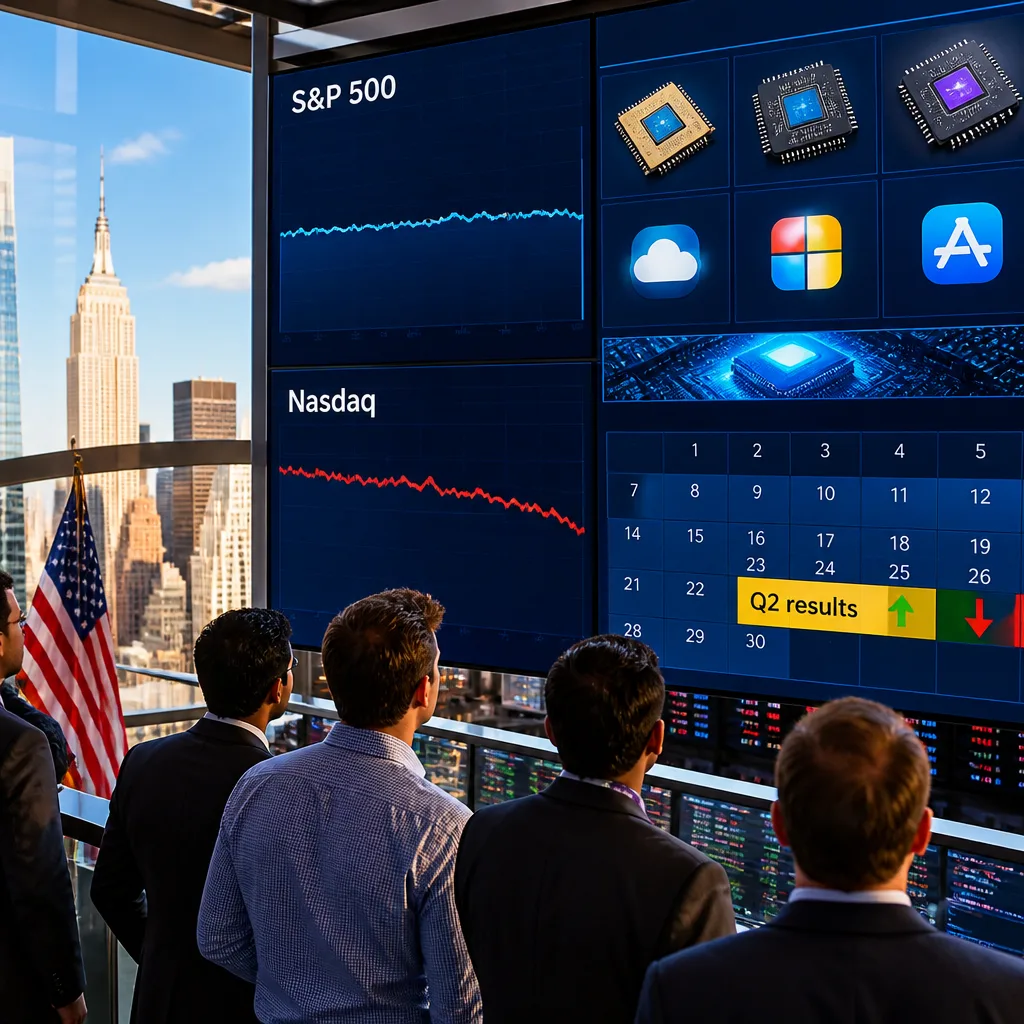
The S&P 500 was essentially unchanged Wednesday as investors waited for second-quarter earnings from major technology companies to test whether heavy spending on artificial intelligence is translating into stronger growth and valuations. The Nasdaq Composite fell amid mixed moves across software and semiconductor stocks, showing the market’s current split between companies that are benefitting from AI momentum and those that are not.
A market split over the AI trade
After months of a broad recovery from March lows, momentum has jittered as heavyweight chipmakers and software firms diverge. The Philadelphia SE Semiconductor index recovered from earlier losses and was up about 1%, seeking a third straight day of gains after being deep in a recent slide. Software shares, by contrast, showed weakness during the session.
"Investors have become a lot more discerning and specific as to where they're choosing to invest in the AI trade," said Kevin Gordon, head of macro research and strategy at Charles Schwab.
Market participants were focused on quarterly reports that could provide fresh evidence about whether multibillion-dollar AI investments are producing returns. Alphabet and Tesla were among the first of the so-called "Magnificent Seven" megacaps scheduled to report after the bell; Texas Instruments was also due to report later in the day.
Benchmarks and sector performance
| Index | Latest | Change |
|---|---|---|
| Dow Jones Industrial Average | 52,312.64 | +90.16 (0.17%) |
| S&P 500 | 7,511.46 | +2.61 (0.03%) |
| Nasdaq Composite | 25,761.74 | -75.47 (0.29%) |
Of the S&P 500’s 11 major sectors, just six were advancing. Utilities led gains about 2%, followed by materials up roughly 1.4%. Consumer discretionary was the weakest group, down about 1%, while information technology swung between losses and gains as investors sorted winners from laggards.
What investors are demanding
The market’s pricing suggests higher standards for technology companies. Analysts and traders say that given lofty valuations tied to AI expectations, merely growing is not enough; companies need to show outsized results or clear payoff from their AI expenditures.
"Companies have to prove not only that they are growing, but that they are worthy of a premium valuation," said Bret Kenwell, U.S. investment analyst at eToro. "Good reports right now are not good enough. They need to be great. And that's the market we're in right now."
- Key reports to watch: second-quarter results from Alphabet, Tesla and Texas Instruments.
- Market signal: chipmakers have recently rebounded but software stocks are under pressure.
- Investor takeaway: earnings must demonstrate that AI spending drives durable revenue or margin improvement to justify premium valuations.
The session underscored a broader theme in equity markets: enthusiasm for AI investments persists, but capital is flowing selectively. Traders are treating quarterly results as a test of whether lofty expectations are supported by measurable business progress, and the near-term outcome will shape whether the market’s recent gains can continue.