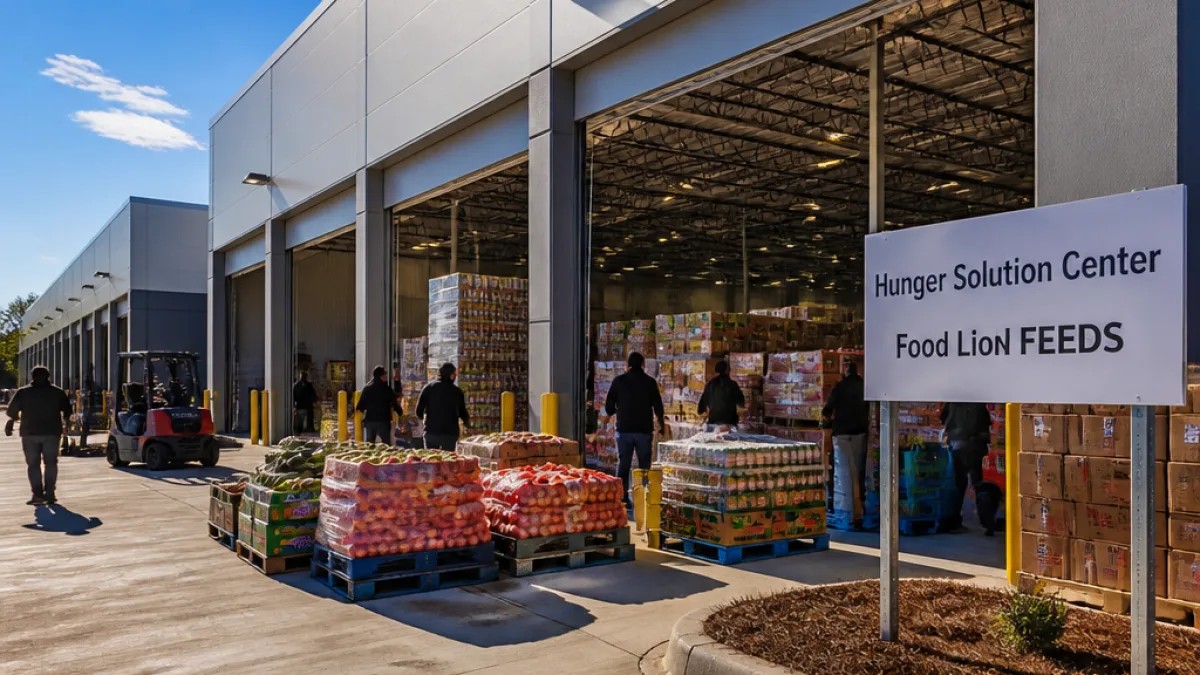
New distribution center intended to speed fresher food to families
The Food Bank of Central & Eastern North Carolina formally opened the Food Lion FEEDS Hunger Solution Center in Durham on Tuesday, a 64,000-square-foot facility intended to expand the region's ability to source, store and distribute food as grocery prices rise and demand on charities climbs.
Located at Welcome Venture Park on Hamlin Road, the center was partially funded by a $1 million investment from Food Lion FEEDS, the grocery chain's charity platform. Food Bank officials say the new hub will strengthen volunteer engagement and advocacy as well as the physical logistics of moving food to families across the branch's six-county service area.
"Communities are facing the worst hunger crisis that we've seen in at least a generation, if not more," said Jason Kanawati Stephany of the Food Bank of Central and Eastern North Carolina.
Officials described a sharp rise in need locally: nearly 97,000 people in the six-county region served by the Durham branch do not know where their next meal will come from. "That's one out of every six neighbors that you and I run into at the grocery store or out pumping gas," Stephany added, underlining how household food insecurity is visible in everyday places.
What the center will do
- Expand the Food Bank's capacity to source and distribute food quickly across the region.
- Coordinate volunteer efforts to increase the speed and scale of local operations.
- Improve handling and distribution of fresh, locally grown produce.
The Food Bank emphasized the new site's advantage in processing fresher food. By moving produce into the facility "straight out of the field," staff and volunteers can package and redistribute perishable items faster than before, the organization said. That capability matters in a moment when higher grocery costs and program changes at the federal level are pushing more households to rely on charitable assistance.
Demand drivers and broader context
Food banks nationwide are preparing for increased need tied to rising grocery prices and shifts in federal food assistance. The nonpartisan Center on Budget and Policy Priorities recently analyzed program participation and reported an estimated 4 million Americans lost Supplemental Nutrition Assistance Program (SNAP) benefits between July 2025 and April 2026. Local nonprofit leaders say those declines are already translating to heavier reliance on community food distribution.
For Durham residents, the new center aims to be both a logistics hub and a visibility tool: it centralizes operations, increases the volume of food that can move through Durham, and creates a base from which to recruit and coordinate volunteers and advocacy efforts across the Food Bank's footprint.
Immediate capacity and what remains unsettled
While officials framed the facility as a meaningful expansion of capacity, they also acknowledged the opening does not by itself resolve rising need. The Food Bank has portrayed the center as a way to move food more quickly and to increase the amount of fresh, local produce reaching communities, but long-term outcomes will depend on sustained funding, volunteer support and the broader policy environment affecting federal benefits and grocery affordability.
| Attribute | Detail |
|---|---|
| Size | 64,000 square feet |
| Location | Welcome Venture Park, Hamlin Road, Durham |
| Lead partner | Food Lion FEEDS (contributed $1 million) |
| Service area | Six-county region served by Durham branch |
Local leaders framed the opening as a necessary investment given rising need. For residents who are volunteering or relying on food assistance, the center represents a more robust local infrastructure. For policy-makers and advocates, it underscores the scale of demand and the interplay between local relief efforts and federal program participation.
As the Food Bank moves food through the new hub, Durham will be a focal point for how community organizations respond to an upsurge in insecurity — testing whether greater capacity and fresher food can blunt some of the effects of higher prices and shrinking benefits.