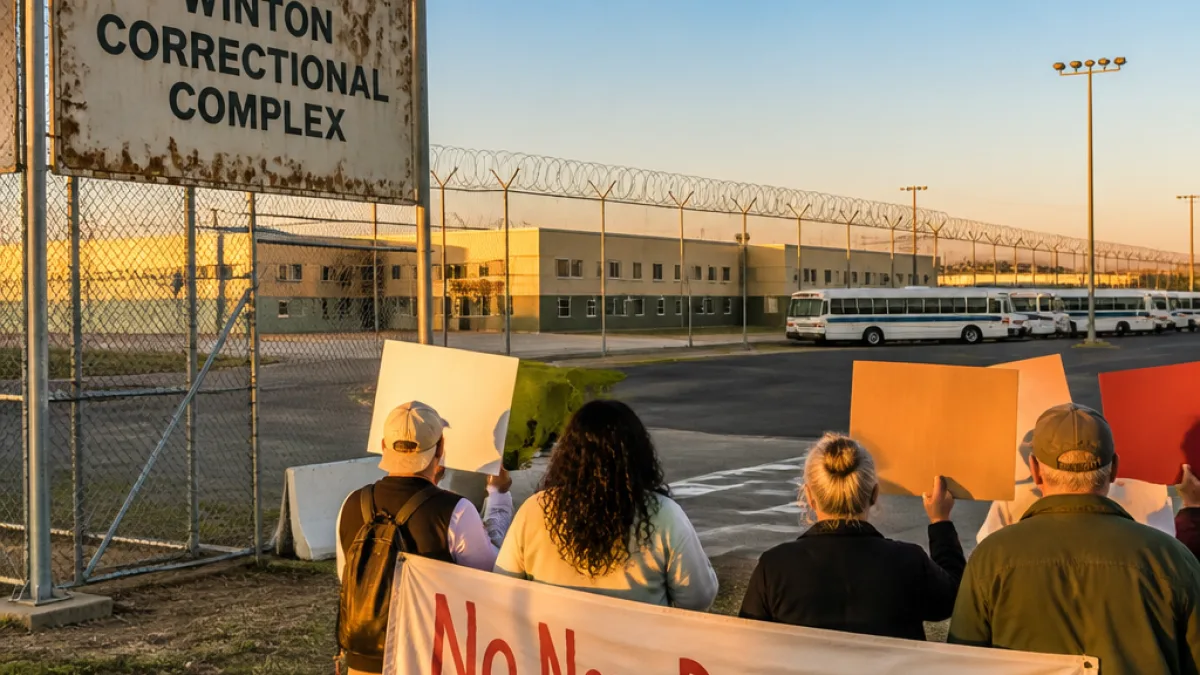
Federal immigration authorities are reportedly preparing to open a major detention center in eastern North Carolina later this year, a development that has reignited debate across the state about private prison contracts, local control and the role of U.S. Immigration and Customs Enforcement in detention operations.
What’s proposed
According to a report by The New York Times, based on internal U.S. Immigration and Customs Enforcement documents, the former Rivers Correctional Institution in Winton would be repurposed as a dedicated federal immigration detention facility. The plan calls for the site to be operated by the private prison company GEO Group and to hold about 1,400 detainees, which would make it among the largest immigration detention centers on the East Coast.
State reaction and public opposition
The proposal surfaced after a week in which activists gathered in Raleigh to press state lawmakers to block any expansion of detention capacity in North Carolina. Protest organizers and civil rights groups have argued that opening a new large-scale facility would deepen the state's partnership with federal immigration enforcement at a time of rising concern about treatment and oversight of detainees.
“The planned ICE detention center in Winton is not state-owned, and I did not approve this transaction,”
North Carolina Gov. Josh Stein wrote on social media that he did not want the facility in the state and said, “Like many other North Carolinians, I do not want it in our state. ICE and Border Patrol have not earned our trust.”
Private operator, federal control
WRAL reporters who covered the story noted the site is a private prison, not a state-owned facility, and a state prison system spokesperson told reporters the department has no authority over the proposal. The New York Times report says ICE reviewed internal plans to house detainees at the facility this fall, and federal documents cited in that report show GEO Group as the intended operator.
Attempts by local media to obtain comment from ICE and GEO Group were not successful in the days after the report.
Context and consequences for the region
If the plan proceeds, the Winton facility would be the first purpose-built federal immigration detention center in North Carolina, shifting a significant enforcement presence into an economically challenged rural county. Advocates warn that large detention centers can strain local services, raise human rights concerns and complicate relationships between immigrant communities and local law enforcement. Supporters of detention capacity often argue it is necessary for federal immigration case processing and to house individuals awaiting hearings or removal.
Activists have pointed to recent events elsewhere — including the closure of a sprawling Florida facility that drew intense scrutiny and protesters who labeled it “Alligator Alcatraz” — as both cautionary tales and motivators for their campaigns.
- Facility: Rivers Correctional Institution (former federal prison)
- Location: Winton, North Carolina
- Operator (reported): GEO Group
- Planned capacity (reported): about 1,400 detainees
- Timeline (reported): expected to open this fall
| Item | Reported detail |
|---|---|
| Site | Rivers Correctional Institution, Winton |
| Operator | GEO Group (reported) |
| Capacity | ~1,400 detainees |
| Expected opening | This fall (reported) |
Questions that remain
Key details remain unresolved publicly: whether ICE will finalize a contract, what federal inspections and oversight will be required, what local economic or security agreements might accompany the facility, and how state officials could influence operations given the site's private ownership.
Community leaders in Hertford County and neighboring areas have not yet released a coordinated response to the Times reporting. Local elected officials will likely face constituent questions about jobs, public safety and humanitarian oversight as the proposal moves forward or stalls.
For now, the report has energized activists who want lawmakers in Raleigh to use every available lever — including public pressure and legal avenues — to oppose establishment of the center. The governor’s statement underscores the limited control state officials have when a private prison operator and a federal agency drive a project on private property, a tension likely to play out as the story develops.
As the situation evolves, NEXO RADAR will continue to monitor official filings, any responses from ICE and GEO Group, and local government actions related to the proposed facility.