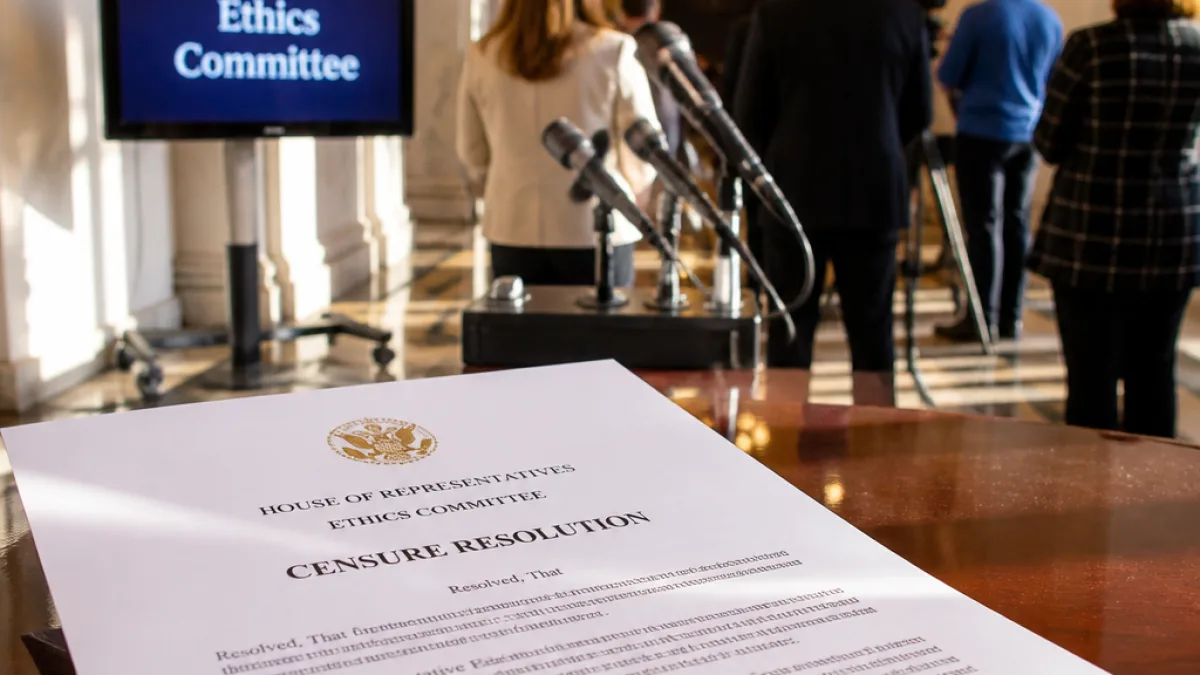
The U.S. House Committee on Ethics has recommended the censure of Rep. Chuck Edwards, R-N.C., concluding there is "substantial reason to believe" the congressman violated House rules related to sexual harassment and maintaining a hostile work environment, according to a committee release made public Monday.
Committee findings and Edwards’ response
The committee’s release said Edwards reviewed a draft of the report "several days prior" and agreed to waive certain procedural steps, allowing the committee to move forward with a recommendation for a House-level sanction. The committee’s statement did not detail the full investigative record in the material provided to the public.
"The Committee findings completely exonerate Representative Edwards under the House rules governing sexual misconduct or harassment; they contradict the committee's conclusion," a spokesperson for Edwards' campaign said in response Monday. "They concluded that he neither engaged in sexual activity with nor explicitly propositioned any individual staff member. They concluded that the allegations in this matter do not implicate quid pro quo sexual harassment. They concluded he did not violate federal sexual harassment law. However, the Committee staff has taken it upon themselves to write their own rules based upon an interpretation that is inconsistent with the written rule of law or House rules."
The campaign statement underscores the dispute between the committee’s interpretation of conduct standards and Edwards’ view that the evidence does not meet statutory or House-rule thresholds for sexual misconduct.
What recommendation for censure means
A recommendation from the House Committee on Ethics is a formal step that asks the full House of Representatives to consider public discipline. Censure is a public rebuke that, if approved by the House, becomes part of the member’s permanent congressional record. While censure carries no criminal penalty, it is one of the most serious forms of congressional discipline short of expulsion.
- Committee findings: The panel said there is "substantial reason to believe" Edwards violated House rules related to sexual harassment and hostile workplace conduct.
- Member cooperation: Edwards agreed to waive certain committee procedural steps after reviewing a draft report.
- Next step: The committee’s recommendation permits the full House to vote on a sanction, which could include censure.
Timeline and procedural details
The committee’s release did not provide a complete public chronology of the investigation in the materials WLOS obtained. A photograph in the report archive shows Edwards at a March 13, 2025, town hall in Asheville, highlighting the congressman’s North Carolina ties as the inquiry moved through Washington procedures.
| Item | Detail |
|---|---|
| Investigating body | U.S. House Committee on Ethics |
| Subject | Rep. Chuck Edwards (R-N.C.) |
| Allegations | Violations of House rules related to sexual harassment and hostile workplace |
| Member response | Edwards disputes the committee’s conclusions and agreed to waive parts of the process |
Local implications and political context
Edwards represents a congressional district in North Carolina, and any formal House sanction would carry political ramifications at home. Public reprimands can influence constituent views, intraparty dynamics, and how party leaders handle committee assignments and campaign support. The committee’s recommendation also adds pressure on House Republican and Democratic leaders to decide how the full chamber will respond.
Because Edwards chose to waive some procedural protections, the committee was able to finalize a recommendation more quickly than a fully litigated process might have allowed. That choice, while expediting the panel’s action, leaves open contested narratives about the underlying evidence and the legal standards applied.
Next steps
The committee’s formal recommendation allows the full House to schedule consideration of a sanction. It will be up to House leadership and the membership to decide whether and when to bring a censure resolution to the floor. If the measure advances, a simple majority vote would be required to adopt it.
For constituents, the immediate practical impacts are political and reputational rather than legal. A censure vote would be recorded and become part of the public congressional record; it could affect Edwards’ committee duties and standing among colleagues depending on the House’s response.
As the process moves forward, local voters and stakeholders are likely to watch how the House balances institutional rules, member accountability, and the competing narratives offered by the committee and Edwards’ campaign.
Reporting continues; the NEXO RADAR will monitor filings from the committee and statements from Edwards’ office as further developments occur.