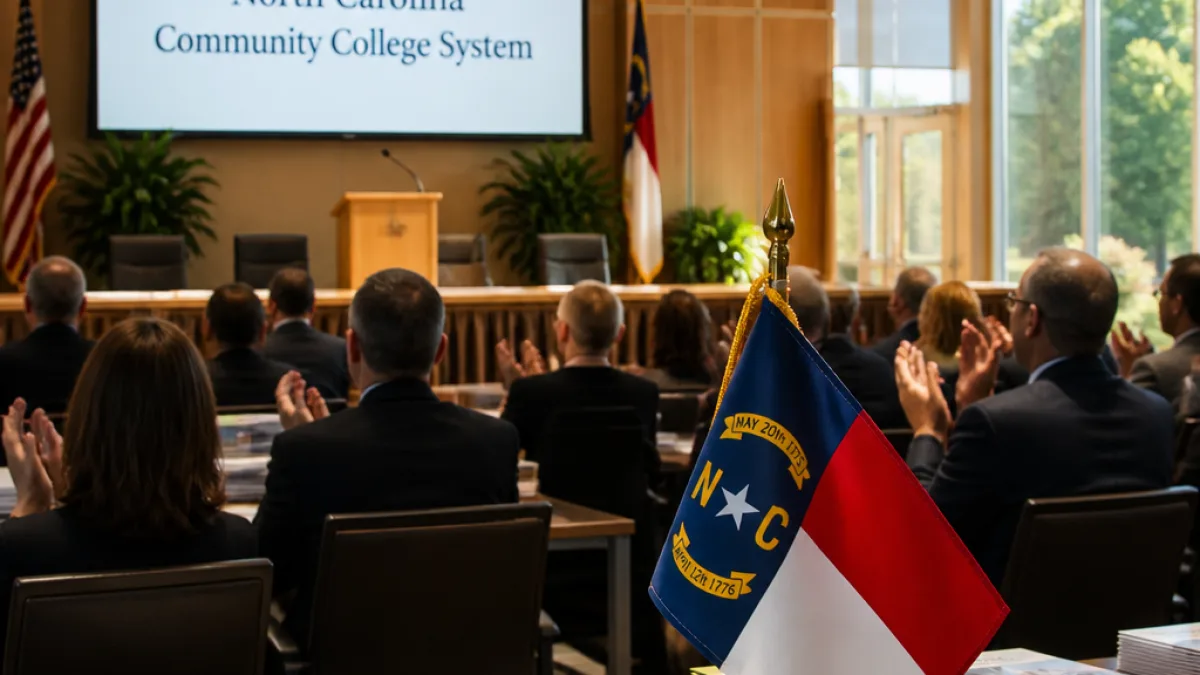
The North Carolina Community College System has selected Dr. Monty Sullivan, a veteran community college administrator from Louisiana, to be its next president, state board leaders announced Thursday. Sullivan would be the system's 12th president and succeeds interim president Bill Carver following a national search.
Experience and track record
Sullivan led the Louisiana Community and Technical College System for 12 years and previously held leadership roles in the Virginia Community College System. During his Louisiana tenure, he is credited with expanding enrollment to more than 130,000 students and helping community colleges double the annual number of graduates, according to the announcement.
"North Carolina's Community College System has built something the rest of the country watches," Sullivan said in a statement. "That work happens across North Carolina — in welding labs, nursing programs, and early college classrooms. I'm committed to reaching every student who wants a better job and every employer who can't find enough skilled workers."
Tom Looney, chair of the North Carolina State Board of Community Colleges, said Sullivan rose to the top after a comprehensive, nationwide search and praised his combination of "passion, experience, vision, character, and proven record."
Policy wins and fundraising
Before retiring in January, Sullivan worked with legislators of both parties in Louisiana to secure more than $500 million in funding for new and modernized training facilities across the state's 12 community and technical colleges. He also helped raise more than $72 million in private contributions for scholarships, endowments and capital projects.
Those achievements are likely to be central to the expectations for the next system leader in North Carolina, a state that relies on its community colleges to supply skilled workers to rapidly growing industries and to provide upskilling for displaced workers.
Leadership turnover and context
North Carolina has had five community college system presidents in the last decade, underscoring a period of turnover at the top of the statewide system. The recent leadership timeline includes Peter Hans, who served from 2018 to 2020 before moving on to lead the University of North Carolina System, and Dr. Jeff Cox, who announced plans to retire earlier this year after a three-year tenure.
The appointment follows a nearly yearlong process after Cox's retirement announcement and comes as system officials emphasize continuity and forward momentum in workforce training and student outcomes.
What this means for community colleges in North Carolina
North Carolina's system serves a large and diverse population of students through 58 colleges across the state. The incoming president will face several immediate challenges and priorities:
- Aligning programs to meet employer demand in manufacturing, healthcare and tech sectors.
- Securing state and private funds for facilities and scholarship programs.
- Improving completion and credential rates while expanding access for rural and nontraditional students.
System leaders have cast Sullivan's record of bipartisan legislative outreach and private fundraising as assets that will help North Carolina expand capacity and modernize training infrastructure.
Numbers at a glance
| Metric | Louisiana system under Sullivan |
|---|---|
| Enrollment | More than 130,000 |
| Increase in annual graduates | Doubled (per board statement) |
| State capital funding secured | More than $500 million |
| Private funds raised | More than $72 million |
Questions ahead
While Sullivan's record in Louisiana is notable, North Carolina's system has its own political and economic context. Legislators and college presidents will be watching how the new leader navigates relationships with the General Assembly, local business partners and the diverse network of college presidents and trustees across the state.
Board chair Tom Looney said the selection committee believes Sullivan can lead "at the speed of business and innovation." Whether that ambition translates into faster program development, larger state or private investments, or measurable gains in student outcomes will be among the first benchmarks used to evaluate his tenure.
The N.C. State Board of Community Colleges will finalize the appointment and announce the start date for Sullivan's term. Until then, interim president Bill Carver will remain in place carrying the day-to-day responsibilities of the system.
As North Carolina continues to court new industries and confront workforce shortages in key fields, the leadership of the community college system will be an important piece of the state's broader economic strategy. Sullivan's arrival will test how experience from another state translates into results here.