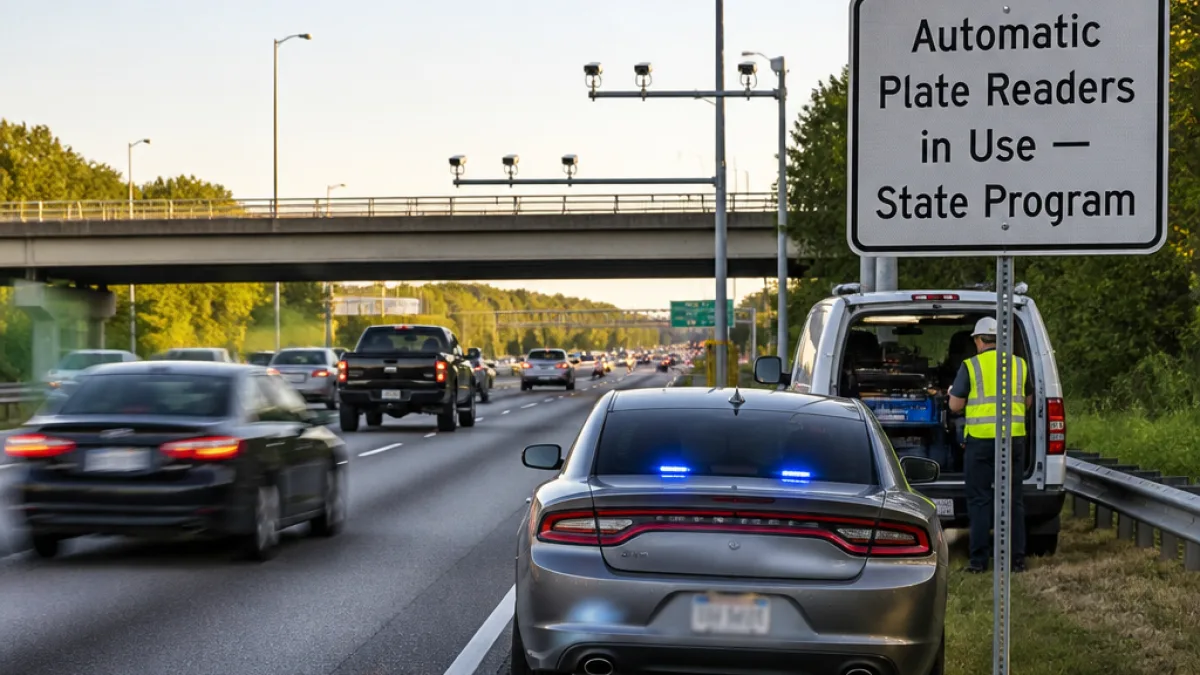
North Carolina has moved a controversial law-enforcement tool from pilot to permanent status after lawmakers included a provision in the state budget allowing the State Bureau of Investigation to authorize cameras that read license plates on state highways and maintained roads.
From test run to statewide program
The devices, commonly known as Automatic License Plate Readers (ALPRs), were first deployed across state-maintained roads in a pilot that began in 2024. During that trial, 32 agencies participated and the systems recorded millions of plate reads on some corridors — including more than 3 million reads in Cabarrus County alone, according to information released by the SBI in April.
The budget language now permits the SBI to enter into agreements to install and maintain ALPR systems and opens participation to law enforcement agencies across North Carolina. Agencies involved in the pilot included the Charlotte-Mecklenburg Police Department, Gaston County Police, the Iredell County Sheriff’s Office, the UNC Charlotte Police and the Cabarrus County Sheriff’s Office.
Law enforcement praises effectiveness
Police leaders say the technology has delivered concrete results, helping investigators locate suspected offenders and recover vehicles tied to criminal investigations. The SBI’s report to legislators cited examples in which ALPR data assisted probes — including the capture of a vehicle allegedly connected to drug-trafficking activity originating in Charlotte.
"These cameras are valuable. Law enforcement relies on them," said Daniel Redford, president of the Charlotte-Mecklenburg Fraternal Order of Police. "With the right parameters and good policies from law enforcement agencies that restrict how these cameras can be used, they have been very valuable."
Privacy, oversight and public concern
Civil liberties advocates say the expansion raises risks of mission creep and broad surveillance if strict limitations are not enforced. The American Civil Liberties Union of North Carolina has voiced concerns that data collection could grow beyond the pilot’s stated purposes or be retained for longer than necessary.
Public reaction in Charlotte and elsewhere reflects a mix of support for crime-fighting benefits and unease about tracking. One resident, Thomas Hinkle, acknowledged a baseline skepticism many feel toward new surveillance technologies.
Data retention and safeguards
During the pilot, the SBI reported that ALPR data were not stored beyond 90 days. The SBI’s April report to the legislature also outlined the pilot’s operation and the partnerships with participating agencies. The new budget provision does not appear in public reporting to change the 90-day retention window, but civil liberties groups say clear statutory limits and independent oversight will be essential if the program expands.
| Metric | Reported figure |
|---|---|
| Participating agencies (pilot) | 32 |
| License-plate reads in Cabarrus County | 3,000,000+ |
| Reported data retention (pilot) | 90 days |
What this means locally
For motorists in communities like Charlotte and Cabarrus County, a permanent program means more consistent deployment of camera arrays along state roads. Prosecutors and investigators gain a steady source of investigative leads; defense attorneys and privacy advocates warn that broader use could make license-plate tracking routine rather than exceptional.
Law enforcement agencies that join the program will need to adopt policies detailing access, use, retention and audit procedures. The debate over ALPRs in North Carolina echoes national conversations about balancing crime-fighting utility against civil liberties.
Questions that remain
- Will statutory safeguards be enacted to define permissible use and prevent mission creep?
- How will oversight be structured to ensure agencies comply with retention and access rules?
- Will local jurisdictions adopt uniform policies or diverge based on agency practice?
The SBI’s publicly released pilot report and the new budget language provide the baseline for the program’s next phase. As the technology moves from experiment to standard practice, lawmakers, police leaders and civil liberties groups are likely to press for more detail on rules and oversight — and for proof that the surveillance benefits justify the risks.
As the state implements the permanent program, residents and local officials can look to forthcoming rulemaking or agency agreements for the specifics on data handling, access controls and transparency measures.