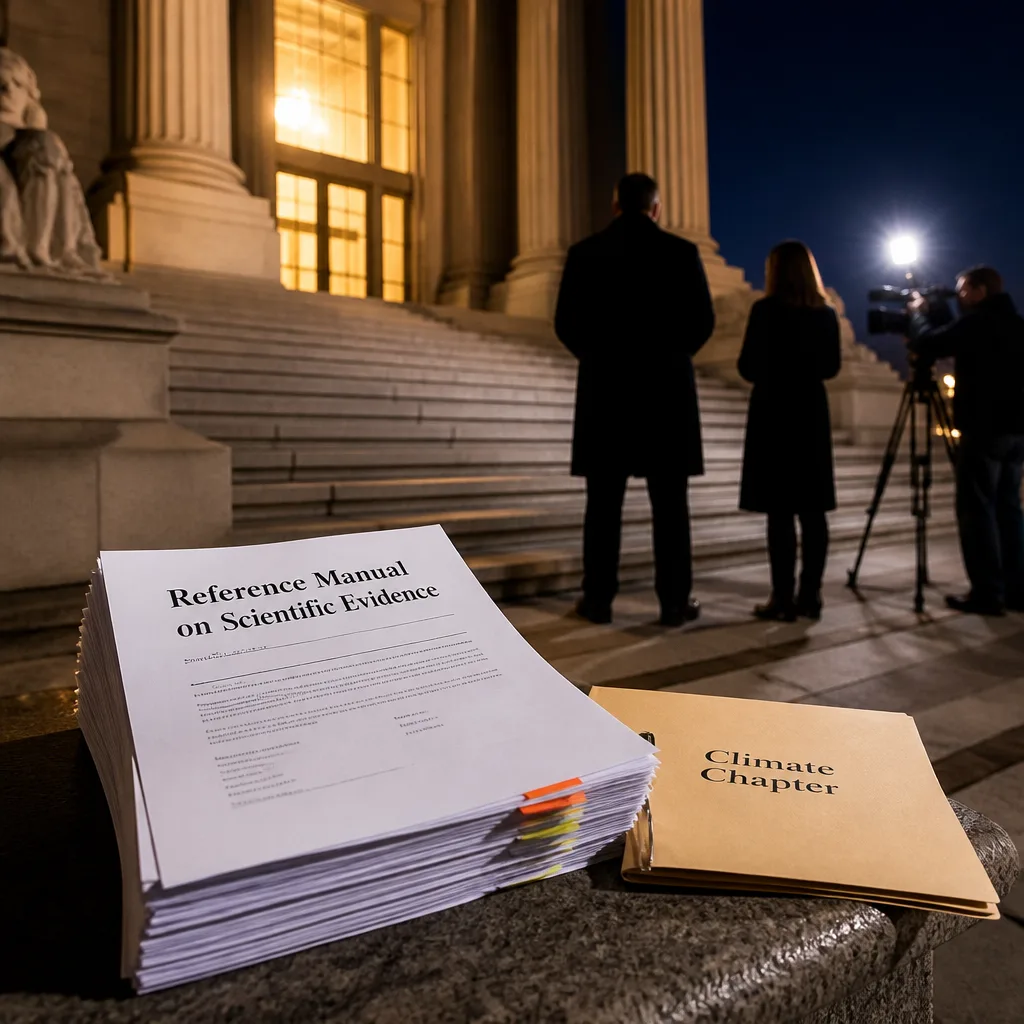
Former President Donald Trump has escalated a confrontation with the nation’s premier scientific institutions, ordering federal officials to review the conduct of organizations tied to a newly contentious chapter on climate science in the Federal Judicial Center’s Reference Manual on Scientific Evidence.
What prompted the review
The immediate flashpoint is a recently published chapter in the Reference Manual that, for the first time, addresses climate science and describes evidence linking fossil-fuel emissions to changes in extreme weather. That chapter has drawn fierce criticism from conservative political allies of the fossil-fuel industry.
On Truth Social earlier this month, Trump accused the National Academy of Sciences of producing “fraudulent, biased, and misleading Manuals on climate change,” and instructed “Federal Suspension and Debarment Officials” to examine the academy’s conduct. His post specifically targeted the guidance that judges use when evaluating scientific testimony in court.
"fraudulent, biased, and misleading Manuals on climate change."
Who's involved and what they did
The dispute has involved several institutions and actors in recent weeks:
- Federal Judicial Center (FJC) — publisher of the Reference Manual, which provides judges with scientific background for courtroom evidence.
- National Academy of Sciences (NAS) — hosts the chapter on its website and is a longstanding independent scientific adviser established in 1863.
- 27 Republican state attorneys general — requested removal of the climate chapter from the Reference Manual, pressuring the FJC.
The FJC responded to the attorneys general by removing the chapter from its own publication. Despite that action, the chapter remains accessible through the National Academy of Sciences’ website, where it continues to be publicly available.
Why this matters
The Reference Manual on Scientific Evidence is a practical tool for judges across the federal system when they evaluate expert testimony. Adding a chapter on climate science means courts have a vetted resource describing the scientific methods and evidence linking greenhouse gases to extreme weather — material that can be cited in litigation involving climate liability, regulation and damages.
Conservative critics and industry allies view the chapter as politically charged because its scientific conclusions can support regulatory or legal claims against fossil-fuel companies and government policies. The episode illustrates how the interplay of law, science and politics can quickly turn a technical manual into a battleground over broader policy questions.
Institutional implications
The National Academy of Sciences, founded during the Civil War to provide independent scientific advice, is now in a strained position. The author of the analysis in the source material identifies as both an NAS member and a climate scientist and warned that the academy’s willingness to host and make the chapter available is being treated by critics as a provocation.
At stake is more than a single document. Observers say the conflict could influence how courts view scientific expertise in cases involving climate harms, and it raises concerns about political interference with organizations that supply impartial scientific analysis to government entities.
| Actor | Action |
|---|---|
| Donald Trump | Ordered review by federal suspension and debarment officials; criticized manual on Truth Social |
| Federal Judicial Center | Removed the climate chapter from its Reference Manual after requests |
| National Academy of Sciences | Hosts the chapter on its website; remained publicly accessible |
Potential consequences and next steps
If federal review leads to formal sanctions or further administrative action, the result could chill collaboration between independent scientific bodies and government agencies or the judiciary. Legal teams, judges and scientists who rely on clear explanations of complex methods may find the landscape more contentious.
For the scientific community, the situation is a reminder that scientific assessments can become political lightning rods — especially on topics like climate change where legal and economic stakes are high. For the courts, the question will be whether alternative sources of vetted scientific guidance can fill the void if established manuals are pared back under pressure.
The episode is unfolding at the intersection of science, law and politics, and it underscores a growing national debate over how independent scientific findings should inform public policy and the judicial process.
— Science Reporter, NEXO RADAR